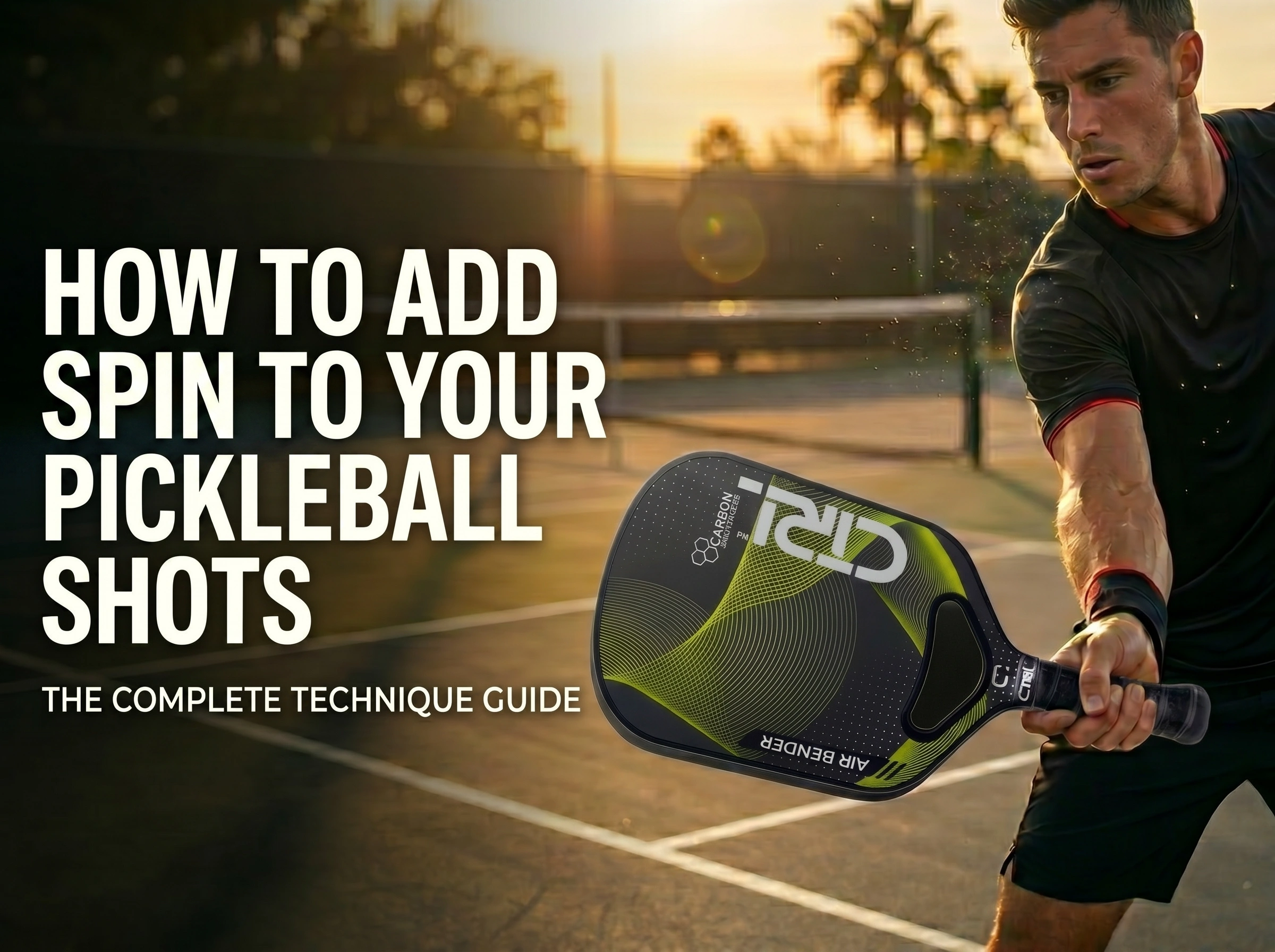
Most recreational pickleball players hit flat their entire lives. Same swing, same angle, same trajectory, and then they wonder why certain opponents make the game feel impossible to read. Those opponents are using spin, and this guide shows you exactly how.Spin changes where the ball lands, how it bounces, and how much time you have to react. A heavy topspin serve kicks sharply up toward your shoulder. A well-placed slice dink skids low through the kitchen and forces you to dig. A sidespin return breaks wide after the bounce and pulls you out of position. None of these are advanced techniques reserved for competitive players. They are skills any intermediate player can build with the right mechanics and consistent drilling.
What is spin in pickleball, and why it matters
Spin is the rotational force applied to the ball at the moment of contact, and it changes both the ball's flight path and how it behaves after the bounce. A ball hit with topspin rotates forward, which makes it dip faster than a flat shot and bounce higher and faster off the court. A ball hit with backspin rotates backward, so it floats slightly through the air and then skids low after the bounce. A ball hit with sidespin rotates laterally, breaking left or right after landing, often unpredictably if your opponent is not reading your contact point.
Why it matters comes down to information. Flat shots are readable. Spin shots force your opponent to process rotation, trajectory, and bounce all at once, which creates hesitation, late reactions, and errors. Players who use spin consistently are not just better athletes, they make the game cognitively harder for everyone they play against.
The three types of spin every player should know
Pickleball spin breaks into three categories, each with a different swing mechanic, ball effect, and tactical use. You do not need all three from day one, but you should understand them so you know which to develop first.
Topspin: drive it down
Topspin comes from brushing the paddle face upward across the back of the ball, producing forward rotation. The ball arcs higher initially, then dips sharply, dropping faster than a flat shot and bouncing higher off the court. That makes topspin drives harder to volley cleanly and topspin serves harder to attack. It is the most widely applicable spin in pickleball and the one most players should build first.
Backspin (slice): keep it low
Backspin, also called slice or underspin, comes from brushing the paddle face downward across the ball, producing backward rotation. The ball floats slightly, then skids low after the bounce, staying below knee height and forcing your opponent to lift it. A well-executed backspin dink is one of the hardest balls to attack at the kitchen line, because it sits at an awkward height and does not bounce up cleanly into a swing. Best used on dinks, reset shots, third shot drops, and returns where you want to neutralise pace.
Sidespin: confuse your opponent
Sidespin comes from brushing the paddle face laterally across the ball at contact, producing rotation that breaks the ball sideways after the bounce. It is the hardest of the three to execute consistently and the hardest for opponents to read, and a well-placed sidespin serve can break six to eight inches off its expected line. Best used on serves and wide returns. Sidespin is an advanced tool, so if your topspin and slice are not reliable yet, build those first.
How to generate topspin: step by step
Topspin comes from swing path, not swing speed. Players who try to hit harder to create spin almost always miss the mechanics. Keep your grip pressure around four or five out of ten, firm enough to control the paddle but loose enough to allow wrist acceleration, and build the shot in six steps.
Step 1: Set your grip correctly. A continental or semi-western grip makes it easier to brush up the back of the ball and generate forward rotation. Hold the paddle firmly enough to maintain control, but avoid squeezing too tightly. A relaxed grip helps create more paddle-head acceleration through contact.
Step 2: Drop the paddle head below the ball. Before contact, the paddle face should sit lower than the ball, which sets up the low-to-high swing path. If your paddle is level with the ball at the start of the swing, you will hit flat.
Step 3: Swing low to high, not straight through. Drive the paddle upward through the contact zone. You are not pushing the ball forward, you are brushing up the back of it. The angle of your swing path determines how much topspin you create: a steep upward brush produces heavy topspin, a shallower angle produces a flatter topspin drive.
Step 4: Contact the ball slightly below its equator. Your paddle should meet the ball on the lower half of its back surface, which is where the upward brushing motion grips the ball and creates forward rotation. Contact too high and you hit flat; contact too far below centre and you pop the ball up.
Step 5: Accelerate through contact. A passive wrist produces weak spin, while an active wrist snap through the contact zone creates rotation you can see and feel. This does not mean a loose, sloppy wrist, it means deliberately accelerating the paddle head through impact. Spin comes from brushing and acceleration, not from simply hitting harder.
Step 6: Follow through toward your target. Finish high, at shoulder height or above. A low follow-through cuts the swing short and reduces both spin and depth, so let the paddle finish the swing naturally rather than stopping it at contact.
How to hit a slice (backspin) shot
The slice is the opposite swing path to topspin and is just as important to develop, because it gives you a completely different look to present to opponents.
Step 1: Open the paddle face. Tilt the top of the paddle slightly back, away from you. An open face lets you get under the ball and brush downward at contact. A closed or flat face will not generate backspin, it will just push the ball into the net.
Step 2: Start the swing high, move it low. The slice path is high-to-low, the exact opposite of topspin. Bring the paddle up above the ball, then brush down and through it. The steeper your downward angle, the more backspin you create.
Step 3: Contact the ball above its equator. You are brushing down the back of the ball from the upper half, which creates the backward rotation that gives the slice its skidding bounce. Contact too low and you hit flat; contact correctly and you will feel the ball grip the surface.
Step 4: Keep your follow-through forward and flat. Unlike topspin, where you finish high, a slice follow-through moves forward at a low angle. Think of cutting through the ball rather than up through it. Do not chop down and stop, let the paddle continue forward.
Step 5: Aim short, into the kitchen. Backspin reduces pace and makes the ball float before it skids, so aim shorter than you would on a flat shot. The kitchen is your target: a slice that lands in the transition zone is easily attackable, while one that lands in the non-volley zone and skids low is not.
How to add spin to your serve
The serve is the one shot in pickleball where you have complete control over pace, placement, and spin before the rally starts, and most players use none of it.
For a topspin serve, use the same low-to-high swing path from the baseline. Toss the ball slightly in front of you, meet it with the paddle below its equator, and accelerate upward through contact. The ball arcs higher than a flat serve, then dips sharply, kicking into your opponent's body or toward their backhand. For a slice serve, open the paddle face and brush down and across the ball at contact. Aimed wide, a slice serve pulls your opponent off the court and gives you a short ball to attack on the third shot; aimed into the body, it creates an awkward low bounce that produces weak returns.
One rule governs spin serves: the ball must be struck below the waist, and the paddle head must be below the wrist at contact. Spin serves within those limits are completely legal, and they are badly underused at the recreational and club levels.
Five drills to build spin consistency
Reading about spin mechanics and executing them under pressure are two different things. These five drills close the gap.
Drill 1: Wall topspin rally. Stand two metres from a flat wall and rally continuously using only a topspin swing path. The goal is not pace but consistent upward brushing at contact. Do it for five minutes before every session, and when your topspin lands reliably on the wall at a consistent height, your contact point is dialled in.
Drill 2: Bucket target dinking. Place a bucket or cone at the back edge of the kitchen and land topspin dinks in or near it from the other side of the net. This forces you to generate enough topspin to dip the ball into the kitchen without hitting long. Start five feet back, then move to seven and ten.
Drill 3: Kitchen topspin control. Stand at the kitchen line with a partner and rally using only topspin dinks, keeping the ball landing in the non-volley zone while maintaining forward rotation. If the ball starts floating long, focus on brushing up the back of it rather than hitting harder.
Drill 4: Cross-court slice rally. With a partner, rally cross-court using only slice shots, with one rule: the ball must stay below net height on its bounce. This forces you to commit to the full high-to-low swing path and a forward follow-through. If you are popping the ball up, your paddle face is too closed at contact.
Drill 5: Figure-eight spin serves. Alternate topspin and slice serves between the deuce and ad courts: one topspin serve, then one slice serve, repeating the pattern for twenty serves. This builds the ability to switch spin types intentionally rather than relying on a single serve under pressure.
Does your paddle affect how much spin you can generate?
Yes, significantly, and it is worth understanding why before you invest in a new paddle.
Surface texture is the biggest factor. A rough, high-friction surface grips the ball longer at contact, so more of your swing energy transfers into rotation rather than forward pace. A smooth or low-friction surface does not grip as long, which reduces spin output even with identical mechanics. Core thickness affects spin indirectly, through ball response: a thinner core produces a livelier, faster response off the surface, while a thicker core absorbs more energy for a more controlled, muted one. Neither is better or worse for spin on its own, but the combination of surface texture and core behaviour sets your overall spin ceiling. Paddle design affects swing speed: a standard edge guard adds mass around the perimeter and increases the paddle's rotational inertia, while an edgeless design removes that drag and lets you swing a faster arc, which at the same effort produces more head speed and therefore more spin.
Those three factors, surface texture, core behaviour, and swing aerodynamics, are what separate a paddle built for spin from one that is not.
Why the CTRL Airbender is built for spin players
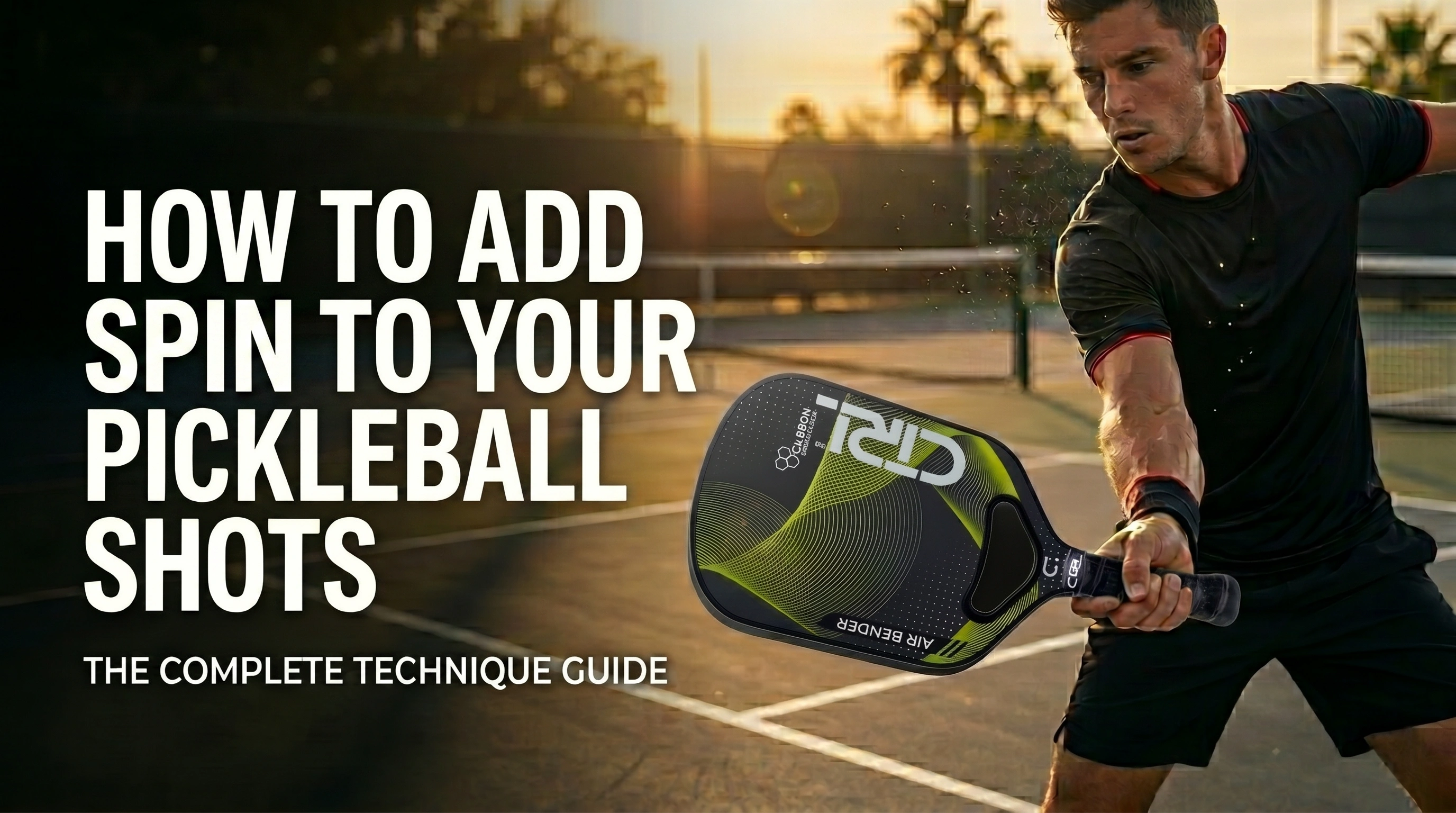
Everything in the section above describes what CTRL engineered into the Airbender. Its True Carbon Friction surface carries a 97 spin rating, the highest in the lineup, because the carbon texture grips the ball aggressively at contact and transfers more of your swing into rotation. Players who switch from fibreglass to carbon consistently report feeling the ball grip in a way their previous paddle did not. The edgeless aerodynamic design removes the edge guard entirely, so there is less drag during the swing and more head speed at contact, which means more spin regardless of technique level. And the 13mm Active Honeycomb Reactive core keeps the ball response lively and direct, so the paddle is both fast off the surface and consistent in how it responds to spin-generating swing paths.
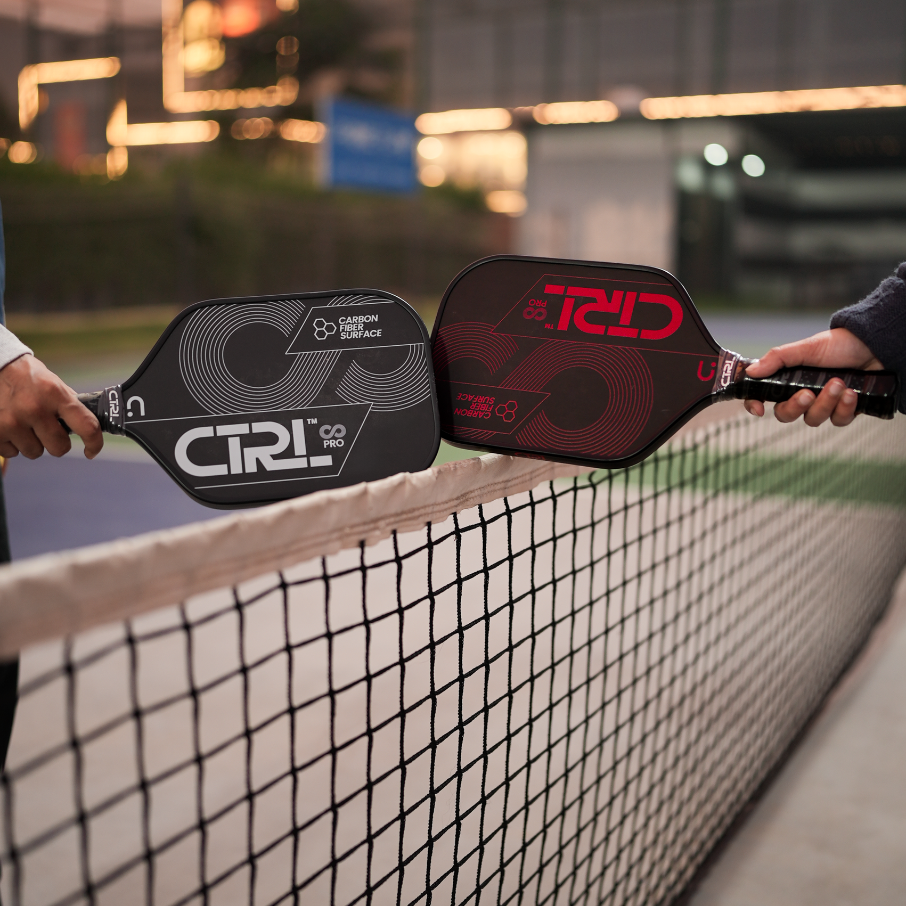
One honest note: the Airbender rewards players who already have their swing mechanics in order. If you are still developing your topspin path, a more forgiving paddle like the CTRL Infinity Pro, which keeps a carbon surface but adds an expanded sweet spot, will serve you better while you drill. Come back to the Airbender when your contact point is consistent, and the spin ceiling you reach will be noticeably higher.
Ready to make your shots harder to return?
Spin is one of the fastest ways to gain an advantage on the court. Master the techniques here, practise the drills consistently, and you will start producing shots that force errors, win free points, and keep opponents guessing, and when you are ready, the right paddle raises your ceiling further. The CTRL Airbender pairs a 97 spin rating, a True Carbon Friction surface, and an edgeless aerodynamic design for maximum spin and speed. If you want to compare spin-focused options first, read the best pickleball paddle for spin guide.