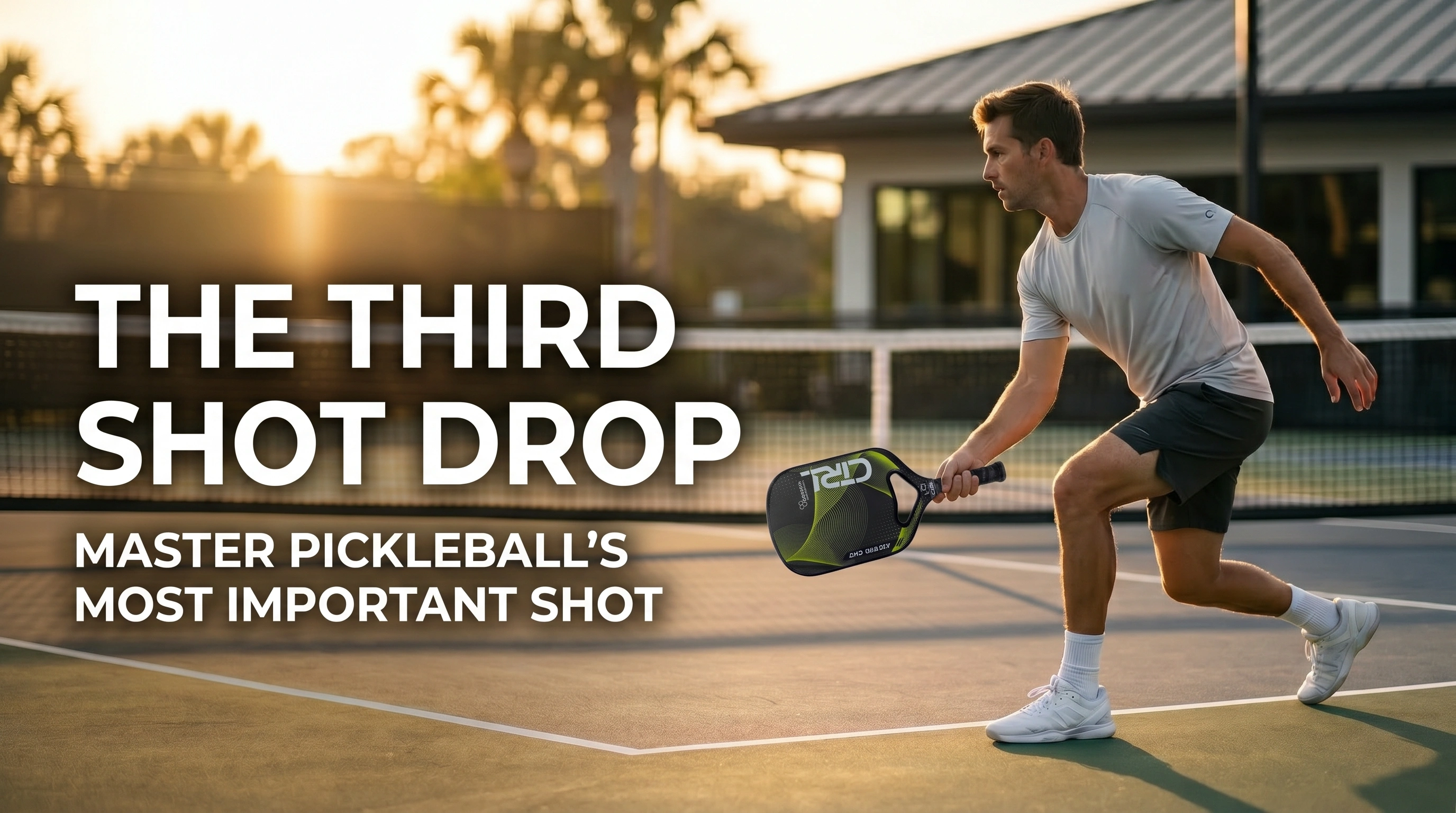
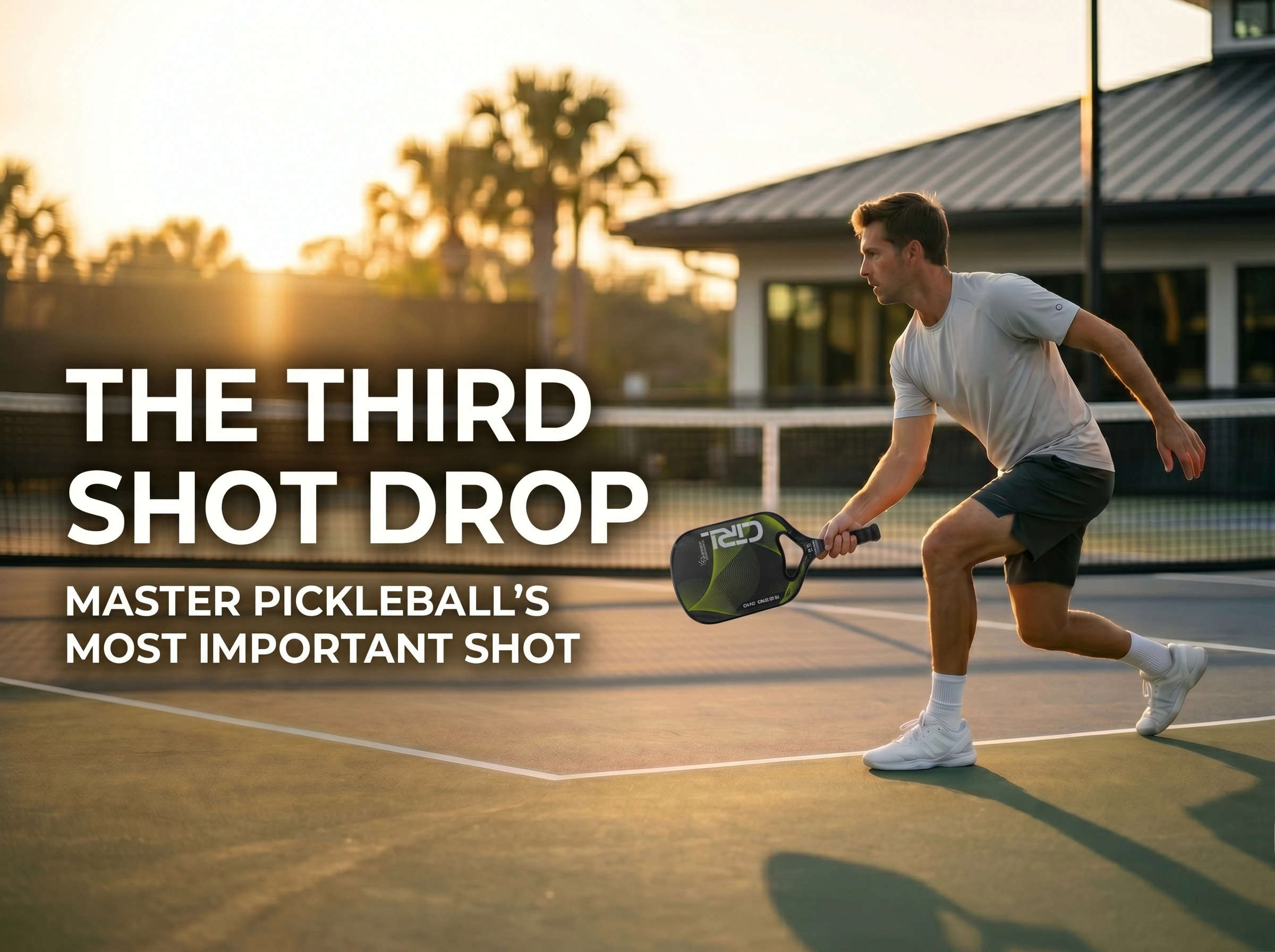
The third shot drop decides who controls the rally before it has really started, which is why coaches call it the most important shot in pickleball. Most players who struggle with it think they have a technique problem when they actually have a framing problem: they know they should hit a soft, arcing drop but keep second-guessing whether to drive instead, and that hesitation shows up as a ball in the net or a pop-up that hands the opponent an easy put-away.
The good news is that the drop is not complicated. It has clear mechanics, specific failure points, and simple tactical logic. Once you understand what it is trying to accomplish, the technique gets easier to build. This guide covers what the shot is and why it matters, step-by-step mechanics, the five mistakes that kill most players' drops, when to drop versus drive, three drills to build consistency, and how paddle choice affects your execution.
What is the third shot drop?
The third shot drop is a soft, arcing shot hit by the serving team on the third shot of the rally, the server's second shot, designed to land in the opponent's non-volley zone and force a dink exchange rather than an attackable ball. The name comes from its position in the rally: the serve is shot one, the return is shot two, and the serving team's response is shot three. The "drop" describes what the ball does: it arcs up off the paddle and drops softly into the kitchen before the opponent can take it at an attackable height. Done right, it lands near the opponent's feet with a low bounce, forcing them to hit upward, which removes their ability to drive or put the ball away and resets the rally to a neutral dinking exchange. It is the only shot that corrects the structural disadvantage the serving team faces at the start of every rally.
Why the third shot drop changes everything
When a rally begins, the two teams are not in equal positions. The receiving team returns the serve and immediately advances to the kitchen line, where they are close to the net, able to attack anything above net height, and working with better angles. The serving team is stuck at the baseline, hitting shot three from the furthest point on the court.
If the serving team drives shot three, they send a fast ball straight to opponents who are perfectly positioned to volley it back at pace. That hands the receiving team exactly the ball they want. A drop changes the dynamic entirely: a ball that lands in the kitchen forces the opponent to let it bounce or take it below the net, and either way they have to hit upward. A ball struck upward from below the net cannot be attacked, only dinked back. While that dink exchange unfolds, the serving team advances toward the kitchen, turning a positional deficit into an even rally. It is not the most exciting shot in the game. It is the one that makes everything else possible.
How to hit the third shot drop: step by step
The drop rewards a compact, controlled swing. Players who over-swing, grip too hard, or rush contact miss consistently. Here is the full sequence.
Step 1: Set your ready position with a split step. As your opponent contacts the return, perform a split step, a small hop that lands just as they hit, loading your legs and keeping you balanced and reactive. From the baseline, your stance should be slightly open, knees soft, weight forward on the balls of your feet. Players who stand flat-footed at the baseline rush their swings; the split step fixes that.
Step 2: Grip the paddle correctly and loosely. Hold the paddle as if shaking hands with the edge of the handle, the continental grip, and keep your grip pressure around four out of ten. A tight grip transfers tension into your swing and produces stiff, uncontrolled contact, and the drop needs a soft, relaxed feel at impact. If your forearm is tense, the ball will not drop, so loosen your hand before you swing.
Step 3: Get into position early. Use small adjustment steps to move behind the ball and set your feet before contact. The more balanced and stable you are, the easier it becomes to control the height, pace, and placement of the drop.
Step 4: Take a compact backswing. The drop does not need a full backswing. Take the paddle back no further than your hip. A big backswing gives more power than the shot requires and makes consistent timing harder, and players who use a full tennis-style backswing almost always drive the ball rather than drop it.
Step 5: Open the paddle face and swing low to high. Before contact, tilt the top of the paddle slightly back into an open face, which lets the ball arc upward rather than drive flat. From there, swing upward through the contact zone, brushing beneath the ball. The combination of open face and low-to-high path creates the arc the drop needs. A closed face produces a drive; a flat face produces a flat ball at net height that opponents can attack.
Step 6: Contact the ball out in front, below the waist. Meet the ball in front of your body, not beside your hip or behind you, which gives you full sight of it through impact and lets you direct it accurately. Keep the contact point below your waist. Drops struck at shoulder height or above are hard to keep soft because gravity works against you, so let the ball drop to a comfortable height before you swing.
Step 7: Follow through forward and high. After contact, let the paddle continue forward and finish high, around shoulder level or above. Players who chop at the ball and stop at contact cut the swing short, reducing arc and depth, and the ball falls short into the net. A full follow-through carries the ball the full distance into the kitchen.
Step 8: Move forward immediately. The drop is not a shot you watch. The instant you make contact, start moving toward the kitchen line. The ball arcs through the air, which buys you time, so use it. Players who admire their drop from the baseline arrive late, get caught in the transition zone, and hand the opponent an easy opportunity. Move as you swing, not after.
Grip and face angle: the two details that matter most
Of all the steps, grip and face angle cause the most lost drops. Players using an eastern grip tend to close the face through the swing and drive the ball, and players who grip too tightly tense up at contact and pop it upward. Practise both in isolation before adding a full swing: stand at the kitchen line, open your face, relax your grip, and let the ball drop off the paddle into the non-volley zone from close range. That builds the tactile feel of correct contact before you add distance and swing path.
A point most guides skip is where to land it. Aim for the middle of the non-volley zone, not the lines or corners, because the middle gives the widest margin: miss by eight inches toward the sideline and you give up an easy wide ball, but miss by eight inches from the middle and you are still in the kitchen. Cross-court drops are also easier than down-the-line drops, since the diagonal gives more net height to clear and a longer flight path, so when in doubt, drop cross-court and save down-the-line for targeting a backhand or a positioning gap.
The five mistakes that ruin most third shot drops
Mistake 1: Hitting it too hard. The most common error at every level is trying to drive and drop at once, which sends the ball through at an attackable height. The fix is to reduce your swing size, not your swing speed: a smaller backswing limits power naturally, without the inconsistent results that come from consciously decelerating at contact.
Mistake 2: Popping it up. The ball floats up to shoulder height, the worst outcome, almost always from a closed face at contact. The fix is to open the face before you start the swing, not during it, because adjusting at impact is too late. The open face belongs in your setup.
Mistake 3: Hitting the net. The drop lands short and clips the tape, usually from aiming too close to the net or swinging downward. The fix is to aim two feet past the kitchen line rather than at it, and to check your swing path, since brushing downward produces backspin that kills the arc.
Mistake 4: Standing still after the drop. You hit a perfect drop, then watch it from the baseline while your opponent dinks it back and you are still eight feet behind the line. The fix is to move forward the instant you make contact. The drop creates a window, and if you do not move through it, you waste the shot.
Mistake 5: Dropping in every situation. The drop is the correct default, but not always correct, and players who drop mechanically miss chances to apply pressure. The fix is to read the return before deciding: if it lands short and you are moving forward, a well-placed drive against a transitioning opponent is better. Drop when both opponents are at the kitchen; drive when they are not.
Third shot drop vs third shot drive: when to use each
This is one of the most searched questions in pickleball and one of the least clearly answered. Use the drop as your default when both opponents have reached the kitchen line, because driving there just gives them an easy volley while dropping forces them to hit up and buys you time to advance. Use the drive when the return lands short and you are already moving forward, when one opponent is still transitioning, against opponents with weak overheads, or when you have been telegraphing your drops and your opponent is cheating forward to anticipate them. The decision should take less than a second: read the return as it comes off the paddle, and if both players are in the kitchen, drop, and if there is a transition opportunity, drive.
Three drills to build a reliable third shot drop
Drill 1: Basket drop to a target. Place a cone or water bottle in the centre of the kitchen, feed yourself balls from the baseline, and drop toward the target. Goal: land 7 of 10 within two feet of the target without popping up or hitting the net. Focus on open face, low-to-high swing, and a compact backswing. Do not move forward yet, isolate the mechanics first. Fifty reps per session.
Drill 2: Partner drop and advance. A partner stands in the kitchen and dinks softly to you at the baseline. You drop and immediately advance, they dink again, you advance again, repeating until you reach the line. Goal: complete the full transition in three drops or fewer without giving up an attackable ball. This pairs the mechanics with the movement pattern the shot is built around.
Drill 3: Live-point drop rule. Play normal points with one rule: the serving team must attempt a drop on every third shot, regardless of the return. This forces execution under live pressure. Track your success rate and aim for 6 of 10 landing in the kitchen without giving up an easy put-away, then start introducing the drive decision on short returns as you improve.
How paddle choice affects your third shot drop
The drop is fundamentally a touch shot: it asks the paddle to absorb pace from the return, convert it into a gentle arc, and land it softly in a small zone from the baseline. Three properties affect how well a paddle does that, and they work together rather than in isolation. Core comes first: a thicker core absorbs more incoming pace and dampens it, which gives more margin on soft shots, while a thinner, livelier core returns energy more directly and is harder to calibrate softly. Weight matters next: a lighter paddle is easier to decelerate through a compact swing, where a heavier one fights you. And surface finishes it: fibreglass gives slightly more dwell time and a softer, more muted response than carbon, which helps on touch shots, while carbon is crisper and livelier. No single paddle maximises all three, so the right choice depends on your level.
The control player's pick: CTRL Infinity Pro
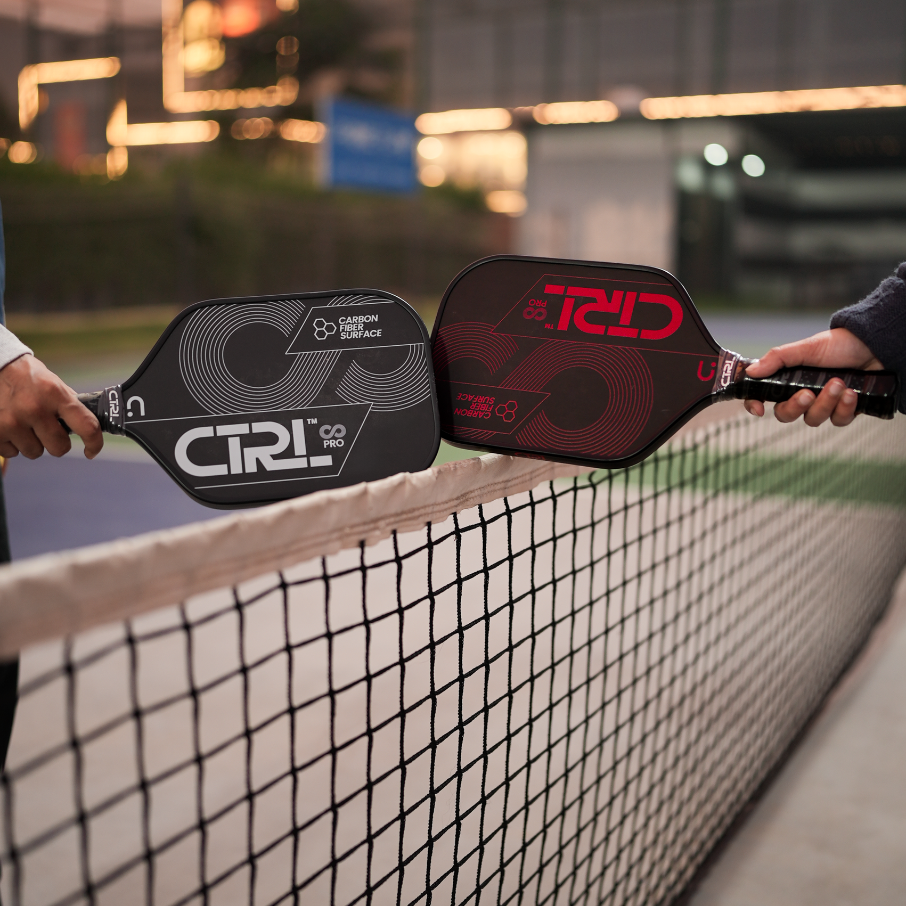
For players who have built their fundamentals and want the most margin on the drop, the CTRL Infinity Pro is the strongest choice in the lineup. Its 16mm core, the thickest CTRL makes, absorbs the most incoming pace and dampens it into a soft arc, and the expanded sweet spot gives the most forgiveness on off-centre drops struck from the baseline, exactly where consistency is hardest. The True Carbon Friction surface is crisper than fibreglass, which advanced players tend to prefer once their touch is calibrated.
Best for competitive and intermediate players with solid fundamentals who want maximum dampening and the largest margin for error on the drop.
The developing player's pick: CTRL Infinity
If you are still building consistency, the CTRL Infinity is the better starting point. It trades the Pro's thicker core for a lighter, more forgiving package: at 220 grams it is the easiest paddle in the lineup to swing compactly without overcooking the shot, and its raw high-friction fibreglass surface gives more dwell time and a softer, more muted contact than carbon, so the ball does not jump off the face. Its 13.3mm Precision Polymer Honeycomb core still absorbs impact smoothly, so you are trading a little of the Pro's dampening margin for lower weight and a more forgiving feel while you learn the shot.
Best for beginners and developing players who want a light, forgiving paddle that makes the compact drop swing easier to build.
The short version: if your fundamentals are solid and you want the most control and margin, the Infinity Pro's 16mm core is the better tool for this shot. If you are still developing, the lighter, more forgiving Infinity is the smarter starting point. Both are USAPA approved and built for control-oriented play. Not sure which fits your game? The best pickleball paddle under ₹5,000 guide compares the full lineup.
Ready to turn defence into control?
The third shot drop is the shot that neutralises your opponent's advantage, gets you to the kitchen line, and puts you in control of the rally. Master the mechanics, commit to the drills, and value consistency over perfection. As your drops get softer, deeper, and more reliable, you will start winning points before the real battle begins, and the right paddle, matched to your level, makes that touch more consistent. Shop the CTRL Infinity if you are developing your game, or the CTRL Infinity Pro if you want more control and a larger sweet spot.