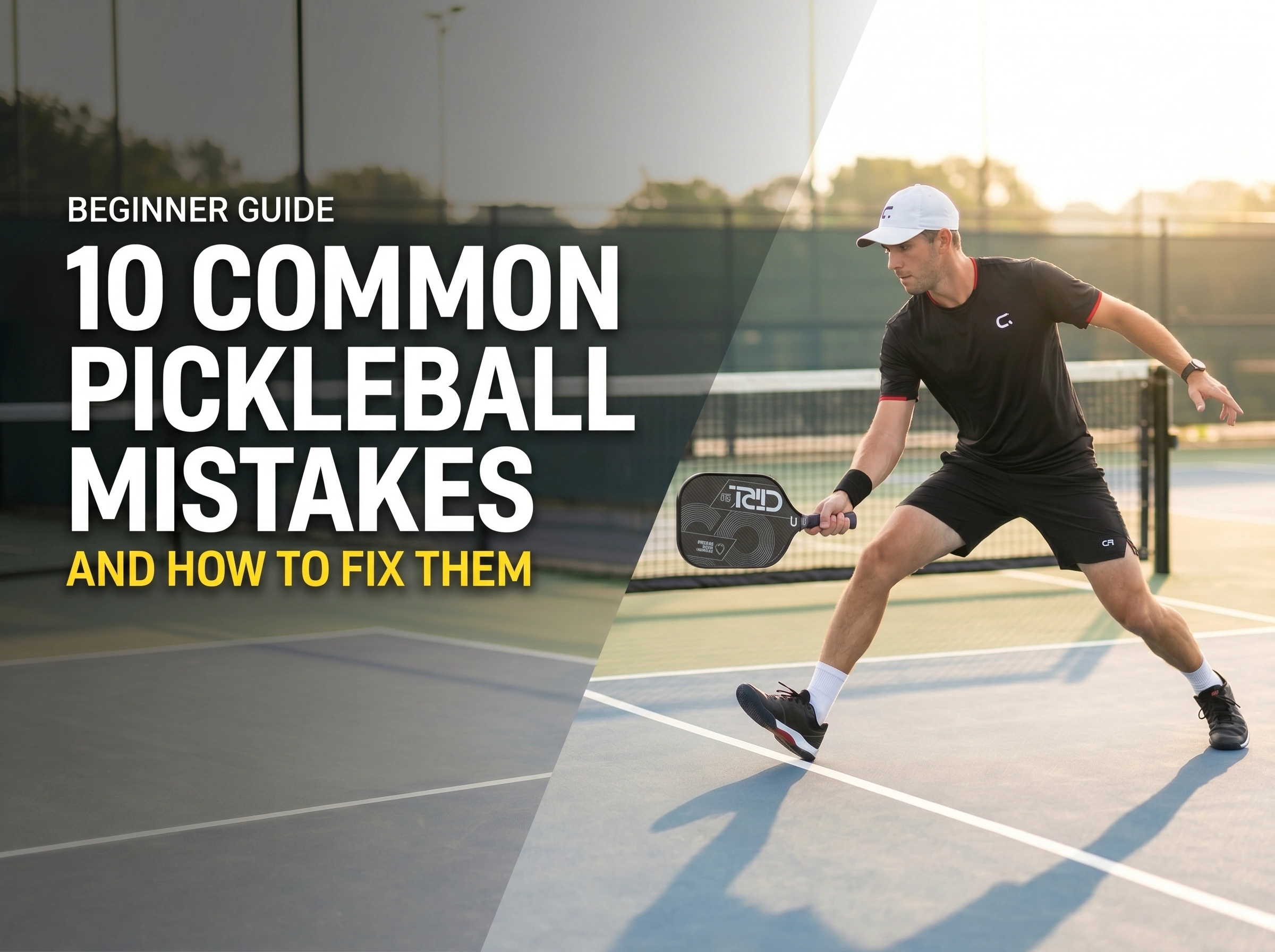
Every pickleball beginner makes more or less the same ten mistakes, not because they lack athleticism or effort, but because pickleball looks deceptively simple until you play it. The gap between what you think you are doing and what you are actually doing stays invisible until someone points it out.
The good news is that these mistakes are predictable, fixable, and almost universal. Everyone in your session has made them, and plenty of players with a year behind them still make several under pressure. This guide names all ten, explains exactly why each one happens, and gives you a concrete fix you can use in your next session, not vague coaching advice.
Mistake 1: Staying at the baseline
Pickleball is not tennis. In tennis the baseline is a legitimate place to build a rally. In pickleball, staying back hands your opponent a structural advantage on every point. When a rally starts, the receiving team returns the serve and immediately moves up to the non-volley zone, the kitchen line, where they have angles, volleys, and put-aways. If you stay at the baseline, you give them all of that while you play from the worst position on the court. The kitchen line is where points are won, and every rally is a race to get there.
The fix: After your third shot, whether a drop or a drive, start moving forward. You do not need to sprint there in one go. Move in stages, pausing in a split step each time your opponent contacts the ball. Three or four advances bring you to the line within a few shots. The habit to build is simple: never stand still at the baseline after you hit.
Mistake 2: Using a full tennis swing
This affects almost everyone arriving from tennis, badminton, or squash. You have spent years building a full-shoulder-rotation swing, and in those sports it works. In pickleball it causes more unforced errors than any other mechanical flaw, because it generates more power than the shots need, makes timing inconsistent over a longer swing arc, and puts your wrist and shoulder in positions that do not match where the ball arrives.
The fix: Deliberately shorten your backswing so it travels no further than your hip. A useful cue is to imagine your elbow is loosely tied to your hip: it can move forward through the swing but not back past your body. Practise it slowly in warm-up until it feels natural. It will feel like you are hitting with no power at first, which is correct, because you need less power than you think.
Mistake 3: Not understanding the kitchen (NVZ) rules
The non-volley zone is the most misunderstood rule in recreational pickleball and the most common source of beginner faults. The rule: you cannot volley the ball, meaning hit it before it bounces, while standing in the non-volley zone or while your momentum carries you into it after a volley. You can step into the kitchen any time to play a ball that has already bounced. The restriction applies only to volleying from inside the zone. The classic fault is stepping across the line while volleying at the net: a player reaches forward to intercept, the front foot crosses the line at contact, and the point is gone.
The fix: Make your kitchen footwork conscious. When you volley at the net, keep both feet behind the line at contact. When you play a ball that has bounced in the kitchen, step in cleanly, hit, then step back out. Do it deliberately until it is automatic.
Mistake 4: Gripping the paddle too tightly
Grip tension is invisible from the outside but shows up as errors across every shot. Beginners squeeze because tightness feels like control, when it does the opposite: tension travels through the forearm into the shoulder and stiffens the whole swing chain. Dinks pop up, volleys lose direction, and touch shots turn unpredictable. Over a long outdoor session in Indian heat, a tight grip also accelerates forearm fatigue and raises injury risk. For most shots, grip pressure should sit around four or five out of ten, firm enough to control the paddle but loose enough for natural wrist movement and energy absorption. For drives and serves you can go to six or seven; for dinks and drops, stay at four.
The fix: Make your ready position the reset point. Between shots, consciously loosen your grip back to four. Check your pressure at the moment of contact, not during the swing, since that is when it matters most. If your forearm is sore after a session, grip tension is almost certainly why.
Mistake 5: Hitting dinks too hard
Beginners often treat dinking as a slower version of driving, the same mechanics at lower pace, which sends balls sitting at waist height where opponents can attack them. A dink is a fundamentally different shot: you absorb the incoming ball's energy rather than adding to it, aiming for a soft arc that lands in the kitchen with a low bounce. The face directs the ball and the swing provides almost no power.
The fix: Use soft hands at four on the grip scale and let the ball come to you rather than reaching for it. Use a slightly open face to create the arc, and aim two to three feet inside the kitchen rather than at the line. If your dinks keep getting attacked, you are adding too much swing, so take almost all of it out and watch what happens. Once your dinking is reliable, the natural next step is the third shot drop, the shot that gets you from the baseline to the kitchen.
Mistake 6: Poor ready position between shots
Watch a beginner in a kitchen exchange and you will see it every few shots: they hit, their arms drop, they stand flat-footed, and the next ball arrives before the paddle comes back up. The ready position is not a formality. It buys you time to react, and without it you always start a step behind. Correct position is weight forward on the balls of your feet, knees slightly soft, paddle in front of your body at chest height, eyes forward and tracking your opponent. As they are about to make contact, add a split step, a small quiet hop that loads your legs and keeps you balanced in any direction.
The fix: Make the split step a conscious habit after every shot. It feels unnatural at first because you are moving while still recovering from your last shot. Drill it deliberately in warm-up rallies, and over two or three sessions it becomes automatic.
Mistake 7: Watching the paddle instead of the ball
This is one of the subtler mistakes, but it noticeably hurts contact consistency. Beginners glance at their paddle during the swing, often to reassure themselves they will hit it cleanly. The head dips, the eyes shift off the ball, and the contact point moves just enough to produce an off-centre strike. The fix is simple in concept but takes conscious effort to build: track the ball from the moment it leaves your opponent's paddle all the way through your own contact, and try to actually see it meet your face. That keeps your head steady, your contact point consistent, and your body in position through impact.
The fix: During practice rallies, say quietly to yourself "see the contact" on every shot for the first ten minutes. It sounds trivial and works faster than any swing adjustment.
Mistake 8: Having no third shot plan
Most beginners play the third shot reactively, sending back whatever feels right in the moment, which produces a random mix of shots with no tactical logic and usually hands opponents an easy ball at a comfortable height. The third shot is the most strategically important shot in pickleball, because it decides whether the rally resets to neutral or continues with your opponent holding the advantage. Playing it without a plan gives away points before the rally has even developed.
The fix: Decide before the return arrives. The default rule: if both opponents are at the kitchen line, play a third shot drop; if one is still transitioning, consider a well-placed drive. Read their positioning as the return leaves their paddle, not after it lands.
Mistake 9: Using the wrong paddle for your level
This one is last among the technique-adjacent mistakes for a reason: it only matters once you practise consistently. But when it does, it matters more than beginners expect. A beginner playing with a heavy wooden bat, a borrowed paddle, or a cheap no-brand composite gets inconsistent feedback on every shot, which makes it impossible to tell whether an error came from your mechanics or your equipment. You fix your grip but the ball still sails long: is that technique, or a stiff core returning too much energy? You adjust the face angle but the dink still pops up: is that the surface, or your contact point?
A well-designed beginner paddle removes that variable. It gives consistent, predictable feedback so that when something goes wrong, you know it came from you and can fix it. In practice that means balanced ratings across control, power, and spin so no dimension punishes you while you learn, a forgiving core that absorbs off-centre hits rather than amplifying them, a featherweight build that lets you swing compactly without fighting the paddle's mass, and a surface with a consistent contact feel rather than a lively, unpredictable one.
The fix: Invest in a purpose-built paddle before you spend on lessons, court time, or other gear. A paddle that matches your level accelerates development, not because it makes you better, but because it stops making you worse.
Mistake 10: Skipping the warm-up
Beginners arrive and start competitive points cold. The first game is inconsistent, timing is off, touch shots are erratic, and they blame their technique rather than the fact that their body and hands are not calibrated yet. Pickleball demands fine motor control: dinking, dropping, and volleying need precise touch a cold body cannot produce reliably. A warm-up is not optional preamble, it is part of the session, and it also matters for injury prevention, since forearm and Achilles strains are far more common in players who go straight from a car seat into competitive play in 35-degree heat.
The fix: Build a five-minute routine and use it every time without exception. Start with light baseline-to-baseline rallying to get your feet and eyes working together, move to mid-court and dink cross-court for two minutes while softening your contact, then finish with five serves on each side, alternating flat and spin. By the time the first competitive point starts, your touch is calibrated and your footwork is active.
How the right paddle fixes half of these mistakes
Several of the mistakes above are pure technique. But several are amplified, or in some cases created, by equipment that does not match the player.
- Mistake 4 (grip tension): a heavy paddle that needs active grip pressure makes it harder to stay loose. A featherweight paddle sits comfortably at relaxed pressure because it does not need a tight hold to stay stable.
- Mistake 5 (hitting dinks too hard): a lively, responsive core returns energy aggressively, so even a soft swing produces more pace than intended. A core engineered for absorption gives you margin, and your soft shots stay soft.
- Mistake 7 (contact inconsistency): a paddle with a narrow sweet spot punishes every off-centre hit unpredictably. An optimised sweet spot gives you the same contact quality whether you catch the ball dead centre or half an inch off.
- Mistake 9 (wrong paddle): the direct version of the problem, equipment that gives inconsistent feedback slows technique development.
A beginner-friendly paddle does not lower your ceiling. It removes equipment noise from your feedback loop so you learn faster.
Why the CTRL Infinity is the best first serious paddle in India
The CTRL Infinity was built around exactly the qualities that accelerate beginner development. Its Precision Polymer Honeycomb core absorbs impact and returns energy smoothly, so off-centre hits feel stable rather than unpredictable and touch shots like dinks, drops, and resets feel controllable. That is the direct fix for Mistakes 4, 5, and 7. At 220 grams it is the lightest paddle in the lineup, which makes the compact swing from Mistake 2 easier to build and hold. The raw high-friction fibreglass surface gives a softer, more forgiving contact than carbon, and for players still building consistency that forgiveness matters more than a higher spin ceiling, though the Infinity still rates a strong 95 for spin. Balanced 95/95/95 ratings across control, power, and spin mean no dimension is sacrificed, which matters because a beginner needs all three to develop at once.
One honest note: the CTRL Infinity Pro is the natural upgrade once your fundamentals are consistent, with a 16mm core and expanded sweet spot for competitive play. But for a beginner building their game, the Infinity is the right starting point. Shop the CTRL Infinity, or if you are weighing the full lineup, read the best pickleball paddle under ₹10,000 guide.