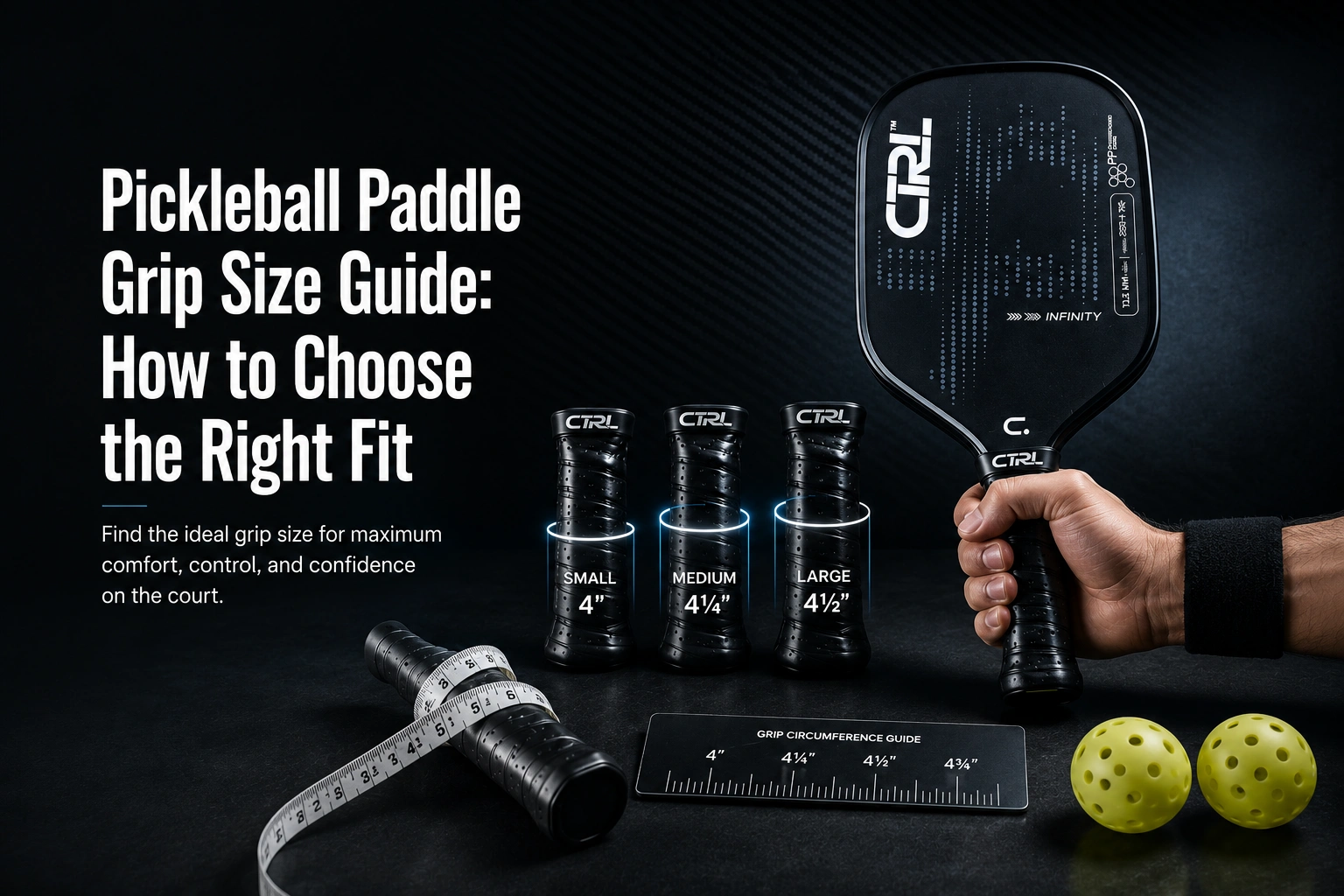
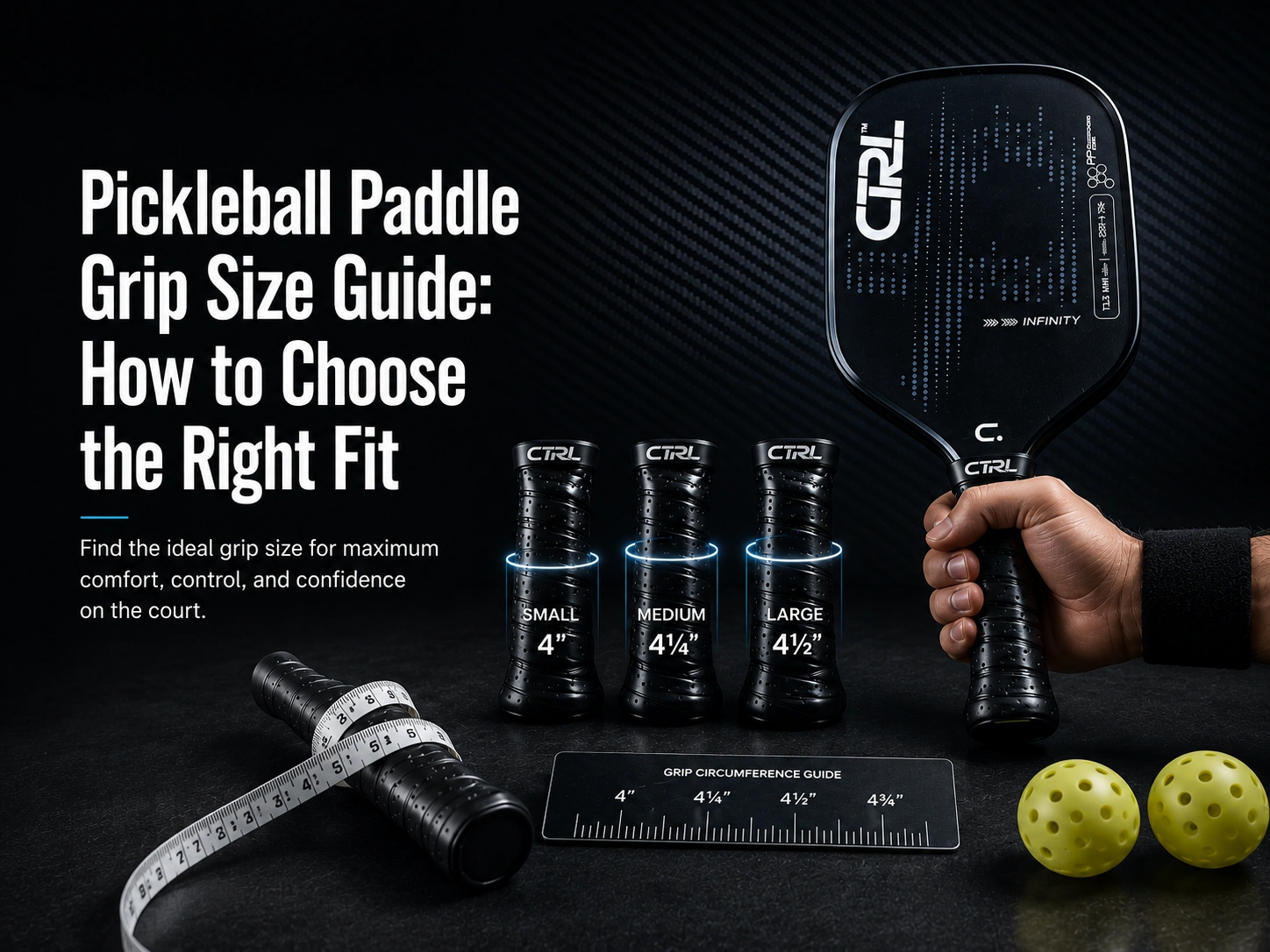
Pickleball paddle grip sizes typically range from 4 inches to 4½ inches in circumference. Players with smaller hands should choose 4"–4⅛", average hands 4¼", and larger hands 4⅜"–4½". The right size prevents wrist strain and improves control - too small causes over-gripping, too large restricts wrist snap.
Grip size is one of the most overlooked specs when buying a paddle, yet it has more day-to-day impact on comfort and control than paddle weight or core material. Here's how to get it right.
How do I measure my hand for a pickleball paddle grip?
There are two accepted methods for measuring your ideal grip size. The first: measure the distance from the tip of your ring finger to the second-largest crease in your palm using a ruler. The second: measure your palm circumference around the base of your fingers, just below the knuckles. Match either measurement to the nearest standard grip size in inches.
Both methods are widely used and tend to produce very similar results for most hand shapes, but if your two measurements land you between two different recommended sizes, the general guidance is to lean toward the smaller size - a slightly small grip can always be built up with overgrip tape, while a slightly large grip has no reliable way to be reduced.
Do I need a professional fitting?
No. The ruler method at home is accurate enough for the vast majority of players - around 95% of buyers will get a comfortable fit using either measurement without needing an in-store fitting. A professional or in-person fitting becomes more useful only at a competitive level, where marginal comfort differences might affect performance in ways a recreational player wouldn't notice.
What happens if my grip size is wrong?
A grip that's too small forces you to squeeze harder to maintain control, which leads to wrist and elbow strain - including a condition sometimes called "pickleball elbow," similar to tennis elbow. A grip that's too large restricts natural wrist snap, reducing spin and softening your touch on dinks and drop shots. Neither issue is always obvious immediately; both tend to show up gradually, as fatigue or discomfort after longer sessions rather than as an instant, easy-to-diagnose problem on your very first swing.
Quick reference:
- Too small → over-gripping, faster fatigue, higher injury risk over repeated sessions
- Too large → limited wrist action, weaker dinks and spin shots
- Right size → better control, less fatigue, longer comfortable play sessions
If you've been playing for a while with unexplained wrist or forearm soreness after sessions, it's worth revisiting your grip size specifically, since it's one of the most overlooked and most fixable causes of that kind of discomfort.
What's the standard grip size range for pickleball paddles?
Grip sizes are standardized across most paddle brands, measured in inches of circumference:
Most recreational players fall into the S–M range, which is why 4"–4¼" paddles make up the majority of stock across most retailers.
Does handle length matter as much as grip circumference?
Handle length is a separate spec from grip circumference, and it matters more than many buyers realize - particularly for players who use a two-handed backhand. Standard pickleball paddle handles typically range from about 4.5 to 5.5 inches, with "standard" length paddles suited to single-handed play and "elongated" or "extended handle" paddles offering more room for a two-handed grip, similar to a tennis backhand.
A longer handle generally shifts more of the paddle's overall length toward the grip and slightly away from the face, which can reduce the effective hitting surface and sweet spot size compared to a standard-length paddle with the same total length. Players who exclusively play a single-handed style typically don't need the extra handle length, while players who use two hands on the backhand - a common technique among players transitioning from tennis - often find an elongated handle meaningfully more comfortable.
If you're unsure which you need, a standard-length handle is the safer default for beginners, since it's more versatile across different shot types while you're still developing your overall technique and haven't settled into a consistent single- or two-handed style.
How does grip size interact with your playing style? {#grip-and-playing-style}
Grip size doesn't just affect comfort - it directly interacts with how much spin and touch you can generate, which makes it worth reconsidering as your playing style develops, not just at your first purchase. Players who rely heavily on wrist snap for spin generation, particularly on serves and topspin drives, generally benefit from staying on the smaller end of their measured range, since a smaller grip allows more freedom of wrist rotation.
Conversely, players who prioritize a firmer, more stable hold - often power-focused players driving from the baseline - sometimes find a slightly larger grip within their comfortable range helps maintain a more locked-in, consistent contact point on harder shots, at some cost to wrist flexibility.
This is part of why grip size isn't purely a one-time measurement exercise: as your game develops and your style becomes clearer, it's worth revisiting whether your current grip size still matches how you actually play, rather than only the size that matched your hand measurement on day one.
Can I adjust a paddle's grip size after buying it?
Yes, grip size can be increased slightly, by up to about ⅛ inch, using overgrip tape. It cannot be decreased. Because of this, if you're between two sizes, it's safer to buy the smaller option and build it up with an overgrip than to buy too large and have no way to reduce it. This is one of the more counterintuitive parts of paddle sizing for new buyers, since most other sporting equipment sizing works in the opposite direction - but with grips specifically, "buy smaller, adjust up" is consistently the safer default.
Does overgrip tape affect paddle weight? Only minimally - a standard overgrip typically adds just 3–5 grams, which most players won't notice during play.
Common grip sizing mistakes to avoid
The most common mistake is skipping the measurement step entirely and guessing based on a general sense of "small," "medium," or "large" hands. Hand measurements don't always match intuition - someone with what looks like a smaller hand can measure into the medium range depending on finger length and palm width, which is exactly why the ring-finger-to-palm-crease method exists as an objective standard.
A few other patterns worth avoiding:
- Buying based on what a friend or teammate uses, rather than your own measurement. Grip size is individual, and even players of similar overall hand size can measure differently based on finger proportions.
- Assuming a slightly-too-large grip will "break in" and feel smaller over time. It won't - foam and synthetic grip materials don't compress meaningfully with use the way, say, a leather baseball glove might.
- Over-correcting with too much overgrip tape in an attempt to fix a grip that's genuinely too small, rather than sizing up to the next standard size. Multiple layers of overgrip change the grip's feel and tackiness in ways that don't fully replicate a properly sized handle.
- Ignoring grip size when buying a second or replacement paddle, assuming it will automatically match a previous paddle. Grip sizing can vary slightly between brands even at the same labeled size, so it's worth re-checking rather than assuming consistency.
What grip size should beginners in India choose?
Most Indian adult players fall into the 4"-4¼" range - smaller on average than typical US and European sizing charts, which skew slightly larger. Beginners should measure their hand and, if between two sizes, start on the smaller end: it's far easier to build up a grip with overgrip tape than to correct a paddle that's too large from day one.
This matters specifically for online buyers, since Indian retailers sometimes stock a narrower range of grip sizes than US-based brands, occasionally skewing toward the larger end of the chart to match international default inventory. If you measure into the XS or S range but a retailer's available stock starts at Medium, it's worth building up a slightly-too-small grip with overgrip tape rather than settling for a paddle that measures noticeably large for your hand - the overgrip solution is both cheaper and more effective than adapting your grip style to compensate for an ill-fitting handle.
If you're still deciding between paddle models altogether, our Best Pickleball Rackets in India 2026 Price Guide covers grip size alongside weight and core material for every budget range.
Find a Paddle That Fits Your Game
Choosing the right grip size is just as important as selecting the right paddle. A properly fitted paddle improves comfort, control, and confidence on every shot while reducing fatigue during long matches. Explore PlayCTRL's premium pickleball paddles, designed with player-friendly grip options and high-performance carbon fiber construction for every skill level.
Shop PlayCTRL Pickleball Paddles →