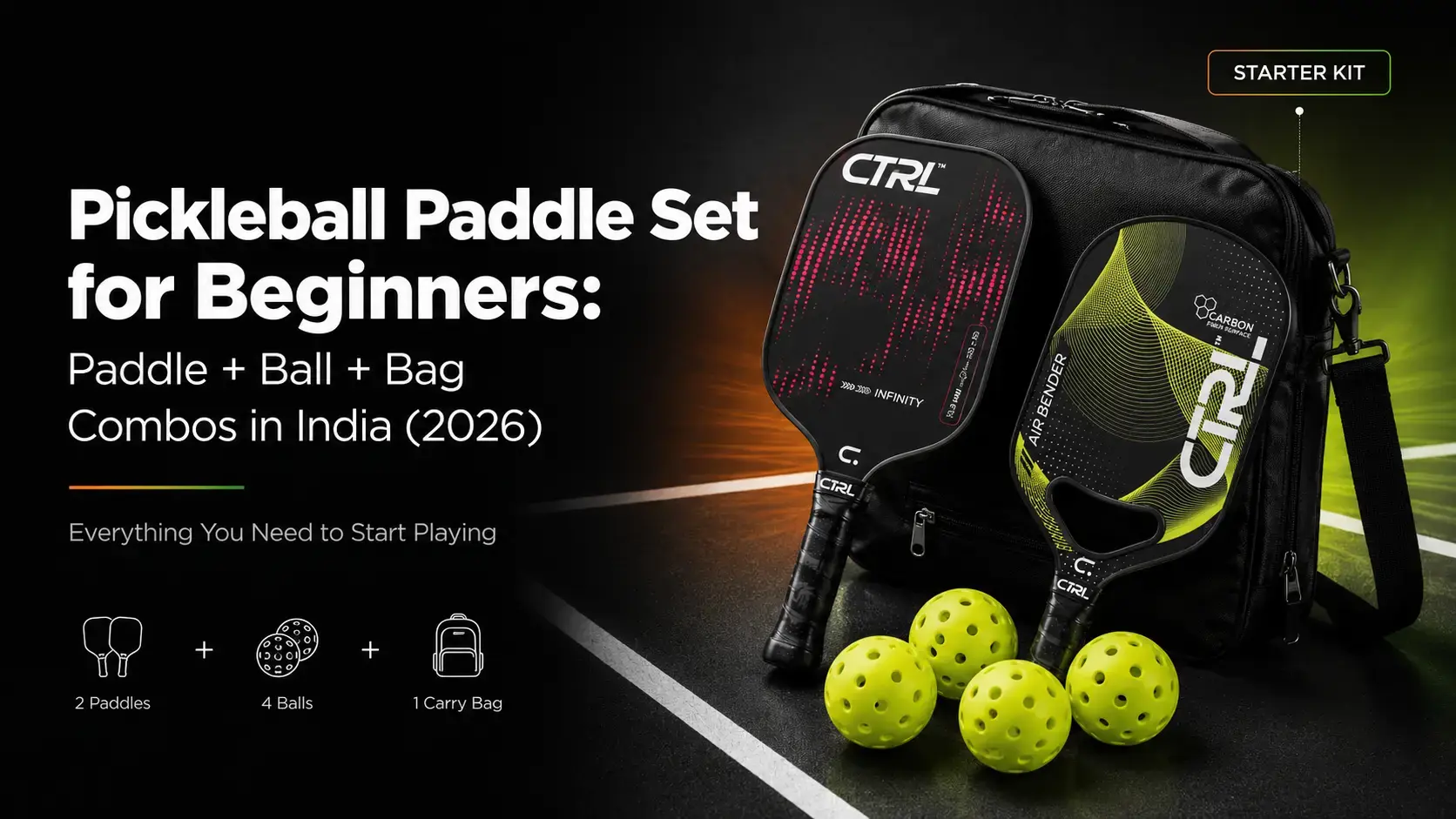
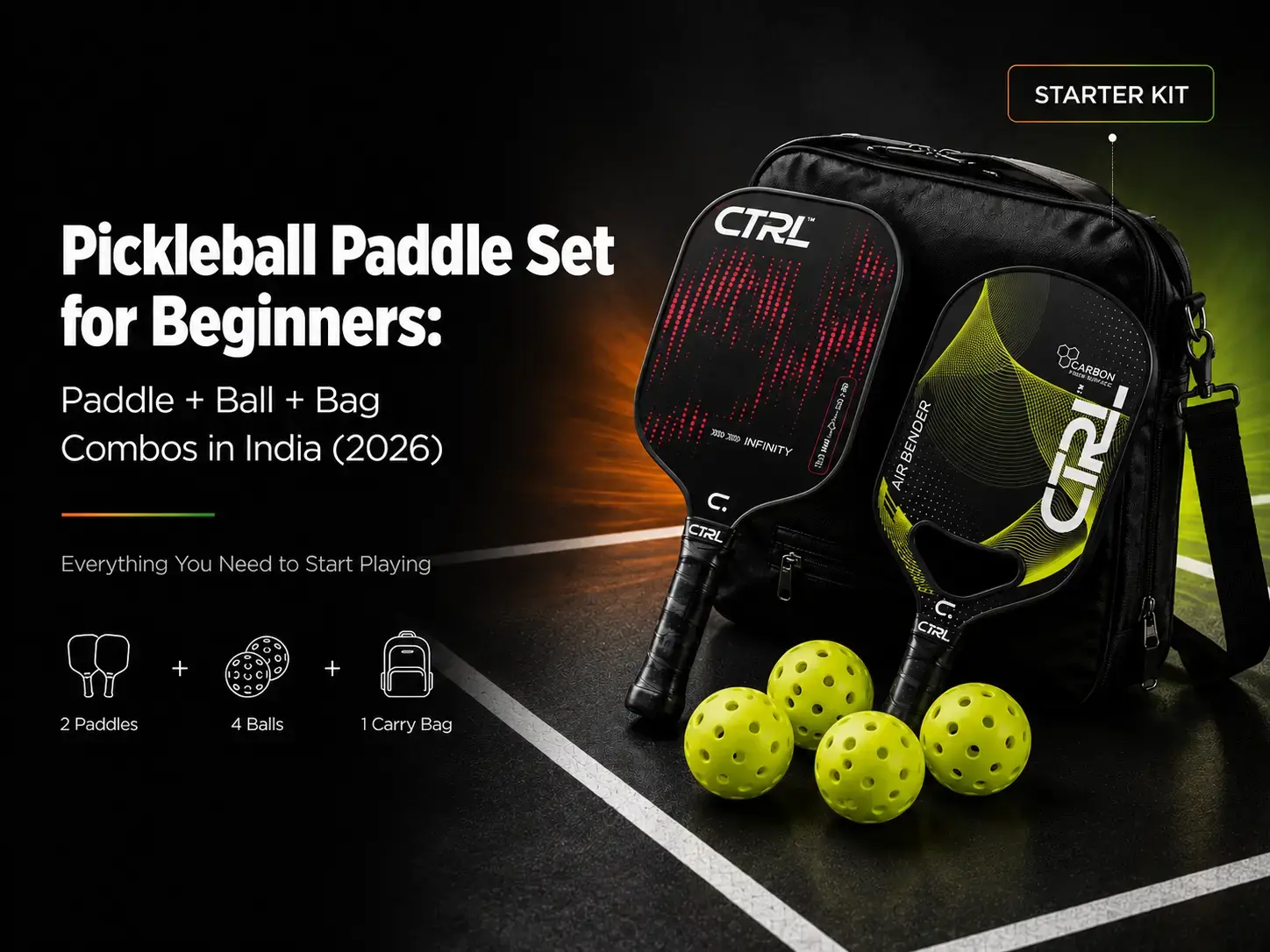
A complete beginner pickleball set includes a control-oriented paddle, two to four balls suited to your court, and a cover or bag to protect them. The paddle decides how you play and how fast you improve. It is the piece you keep and build your kit around. For a set that lasts beyond your first month rather than one you replace, expect to spend roughly ₹3,000-6,000, not the ₹1,500 all-in-one bundles sold on marketplaces.
If you are buying your first kit, this is an honest breakdown of what belongs in it, whether to buy a ready-made set or build your own, how much you should spend, and which paddle to anchor it around.
What's actually included in a pickleball set?
A complete beginner set consists of three essentials plus one or two optional extras. Understanding what each part does and where to spend versus saving is the difference between a kit that grows with you and one you replace in weeks.
The paddle is your core equipment and biggest influence on how you play. For beginners, the right choice is a lightweight, control-first paddle rather than a heavy, power-focused one that tires your arm and scatters shots while you learn placement. A control paddle keeps the ball on the face slightly longer, giving you the feel to develop touch, consistency, and shot placement. These skills win pickleball points at every level below professional, not raw power.
The balls matter more than most beginners expect because pickleball balls are not interchangeable. Outdoor balls are harder, with smaller, more numerous holes designed to cut through wind. Indoor balls are softer, with larger holes and a slightly different bounce and flight. Most courts in India are outdoor hard courts, so outdoor balls are your default, with a couple of indoor balls worth keeping for monsoon months when play moves inside. Using the wrong ball type is a common reason a beginner's game feels inconsistent without them knowing why.
The bag or cover is the part people skip and later regret. At minimum, a paddle cover shields the face from scratches, heat, and humidity, all of which take a toll in Indian conditions. A paddle left in a hot car boot or humid kit bag degrades faster than one that is protected. A full carry bag is a bonus if you travel to courts regularly, giving you room for spare balls, a water bottle, a towel, and overgrips.
Here is the quick checklist:
What to skip for now: a second paddle unless you have a regular playing partner, and anything labelled "pro" before your first ten sessions. Beginners often over-buy accessories and under-buy the paddle, which is backwards.
Should you buy a pickleball set or build your own?
This is the real decision, and the honest answer is that it depends entirely on where the money goes.
A pre-packaged set is convenient and looks cheaper on paper. The catch is most budget all-in-one sets save money where it hurts most: the paddle. A ₹1,500–2,000 combo typically pairs a flimsy paddle you will outgrow within weeks with non-standard balls that do not reflect how the game is played. You are paying for packaging and one-click convenience, not equipment that will serve you as you improve.
Building your own costs slightly more upfront but gives you a paddle that grows with you and balls suited to your courts. For most beginners, the smart path is to choose the paddle first, then add balls and a cover. The paddle is the part you keep; balls and bag are inexpensive and easy to add later and replace as they wear out.
There is a predictable pattern to avoid. Many players who start with the cheapest all-in-one set shop for a replacement paddle within 2 to 3 months, once they reach the performance ceiling. They have spent money twice: once on the throwaway kit and again on the paddle they should have bought initially. The upgrade path is not free either; the old paddle usually gets abandoned rather than handed down.
The honest framing: a ready-made budget set for "let me try this cheaply once," and a paddle-first buiThe honest framing: a ready-made budget set for "let me try this cheaply once" and a paddle-first build for "I know I will keep playing." If you are fairly sure pickleball will be part of your routine, the paddle-first approach saves you money over the first year and improves your game your attention - and most of your budget - should go. Four specifications matter most for a beginner.
Weight is the first thing to get right.
For Indian outdoor courts, 220–230g is the sweet spot. It is light enough to protect your forearm and elbow while you build technique and stable enough for consistent contact. Paddles that are too heavy cause fatigue and, over time, elbow strain that new players often complain about. Paddles that are too light feel unstable and get pushed around on faster shots. The mid-weight range is forgiving for someone developing a swing.
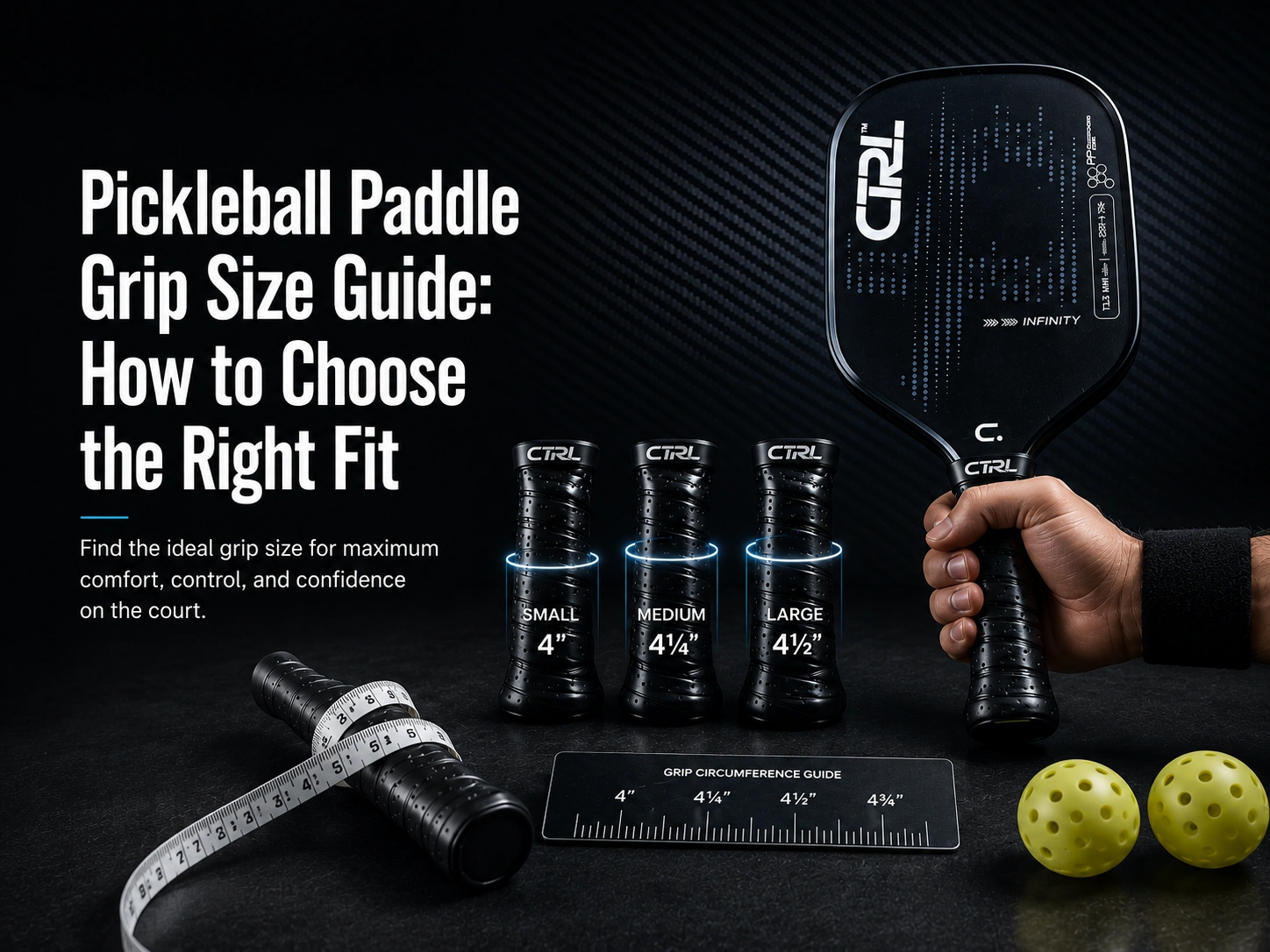
Grip size affects control more than beginners realize.
A grip that is too large forces you to squeeze harder, killing touch and tiring your hand. A grip that is too small lets the paddle twist on off-centre hits. Most players do well with a standard grip fine-tuned with an overgrip. You can build a grip up but cannot easily make it smaller.
Face material shapes how the paddle plays.
A control-first surface, whether fibreglass or carbon, helps you place shots and keep rallies alive, which is how beginners improve, not by swinging harder. Fibreglass offers a softer, more forgiving feel and a touch more natural pop, while carbon offers more grip for spin and a more consistent response across the face. Both are good beginner surfaces. The important thing is that the paddle is built for control rather than being a stiff, powerful board that punishes imperfect contact.
USAPA approval confirms the paddle meets official standards, so you are learning on legitimate equipment rather than a toy. It also means that if you ever join a club, ladder, or local tournament, your paddle is already eligible - you will not have to rebuy to play competitively.
This is the tier the CTRL Infinity was built for. It is a 220g featherweight with a 13.3mm Precision Polymer Honeycomb core and a raw high-friction fibreglass face, carrying balanced 95/95/95 control, power, and spin ratings, and it is USAPA approved. In practice, that means light, forgiving, and control-oriented - exactly what a beginner needs - without being the kind of throwaway paddle you replace within a month. It sits at the point where a first paddle stops being a compromise and starts being something you can grow into for a year or more.
Which pickleball set is best for beginners in India?
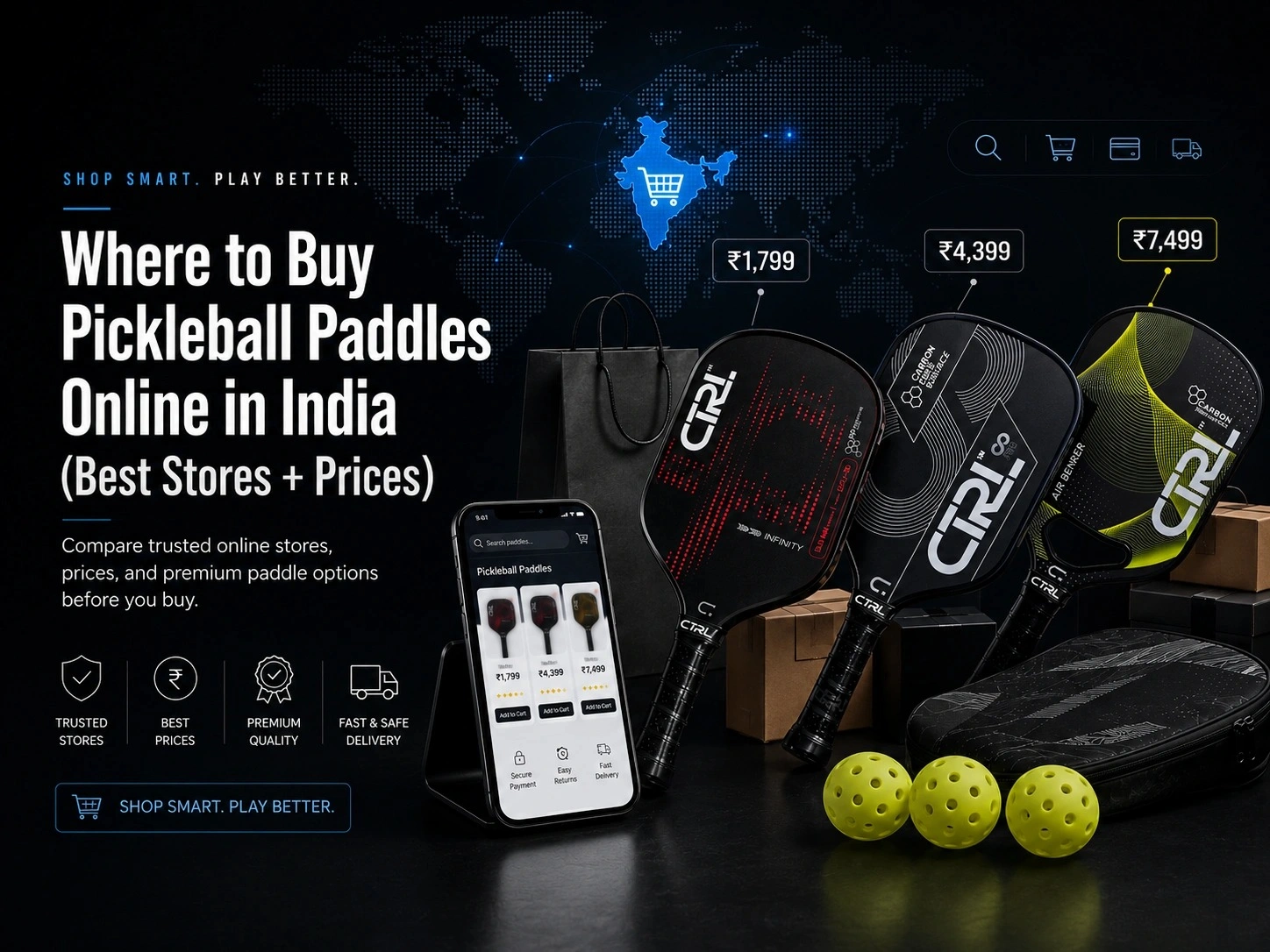
For most beginners in India, the best approach is to anchor the set around a quality control paddle and add the rest. Here is how the common options compare:
The CTRL Infinity fits the range that makes sense for a beginner: real paddle quality without premium pricing, shipped brand-direct with a warranty and 14-day returns, so you are covered if it is not the right fit. Buying brand-direct also means consistent pricing and genuine after-sales support rather than varying stock quality and intermediated support from reseller imports.
Shop CTRL Pickleball Paddles →
Indoor vs outdoor: which balls does your set actually need?
This deserves its own section because beginners often build the wrong set here. The balls you choose should match where you play, and in India, that changes with the season.
Outdoor balls are the default for the majority of the year, because most Indian courts are outdoor hard courts, and outdoor balls are engineered to hold a stable flight in wind. They are harder and have smaller holes, so they play faster and last reasonably well on abrasive surfaces.
Indoor balls come into their own during the monsoon, when play moves under a roof. They are softer, with larger holes, and give a slightly slower, higher-bouncing game that suits smooth indoor floors. If you live somewhere with a long monsoon or you know you will mostly play indoors, weigh your set toward indoor balls.
For a starter set, a sensible mix is two to four outdoor balls plus one or two indoor balls, so you are covered whichever way weather and court availability push you. Balls are inexpensive and wear out with use, so treat them as consumables you top up rather than a one-time purchase.
How much should a beginner's pickleball set cost in India?
Beginner sets fall into three broad tiers. Knowing which tier you buy into prevents both overspending and a false economy.
The ₹1,500–2,500 tier is all-in-one throwaway combos. These are fine only if you want to try the sport once with no real intention of improving. The paddle is the weak link and will show once you play more than occasionally.
The ₹3,000–6,000 tier is the real starter range and where a paddle like the Infinity sits. It offers enough quality to learn properly, develop technique, and keep playing for a long time. For most people reading a guide like this, which signals more than passing interest, this is the correct tier.
The ₹7,000+ tier is premium carbon paddles and full kits. This is excellent gear, but more than a first-timer needs on day one. The sensible move is to start in the middle tier, learn your style, and upgrade deliberately later - for instance, to a carbon paddle for more spin, or a spin-focused premium model once you know that is the game you want to play.
For most people, the middle tier is the right call, because spending ₹3,000–6,000 once beats spending ₹1,500 twice. The cheapest option is only cheap if you never improve; the moment you do, it becomes the more expensive path.
How to make your beginner set last
A good set is an investment, and a little care keeps it performing. Store your paddle in its cover, away from direct heat - a paddle left in a hot car or in direct sun can suffer core and face damage over time, and Indian summers are unforgiving. Wipe the face down after play to clear dust and grit, which preserves the surface texture that gives you grip on the ball. Rotate and replace your overgrip once it goes slick with sweat, especially in humid months, because grip is cheap and a slipping handle costs you control and invites strain. Keep balls out of extreme heat, too, since they can warp and crack. None of this is demanding, and it is the difference between a paddle that lasts a full season or more and one that quietly degrades in a few months.
Ready to start playing?
If you want one recommendation to build your beginner set around, it is the CTRL Infinity - light, control-first, USAPA-approved, and built to grow with your game rather than get replaced in a month. Add a few outdoor balls and a cover, and you have a complete kit that will carry you well past your first season.
Buy brand-direct from CTRL, and you get consistent pricing, a full brand warranty, 14-day returns on unused paddles, and real support at +91 99997 79794 or support@playctrl.co (Monday to Friday, 8 am to 10 pm).