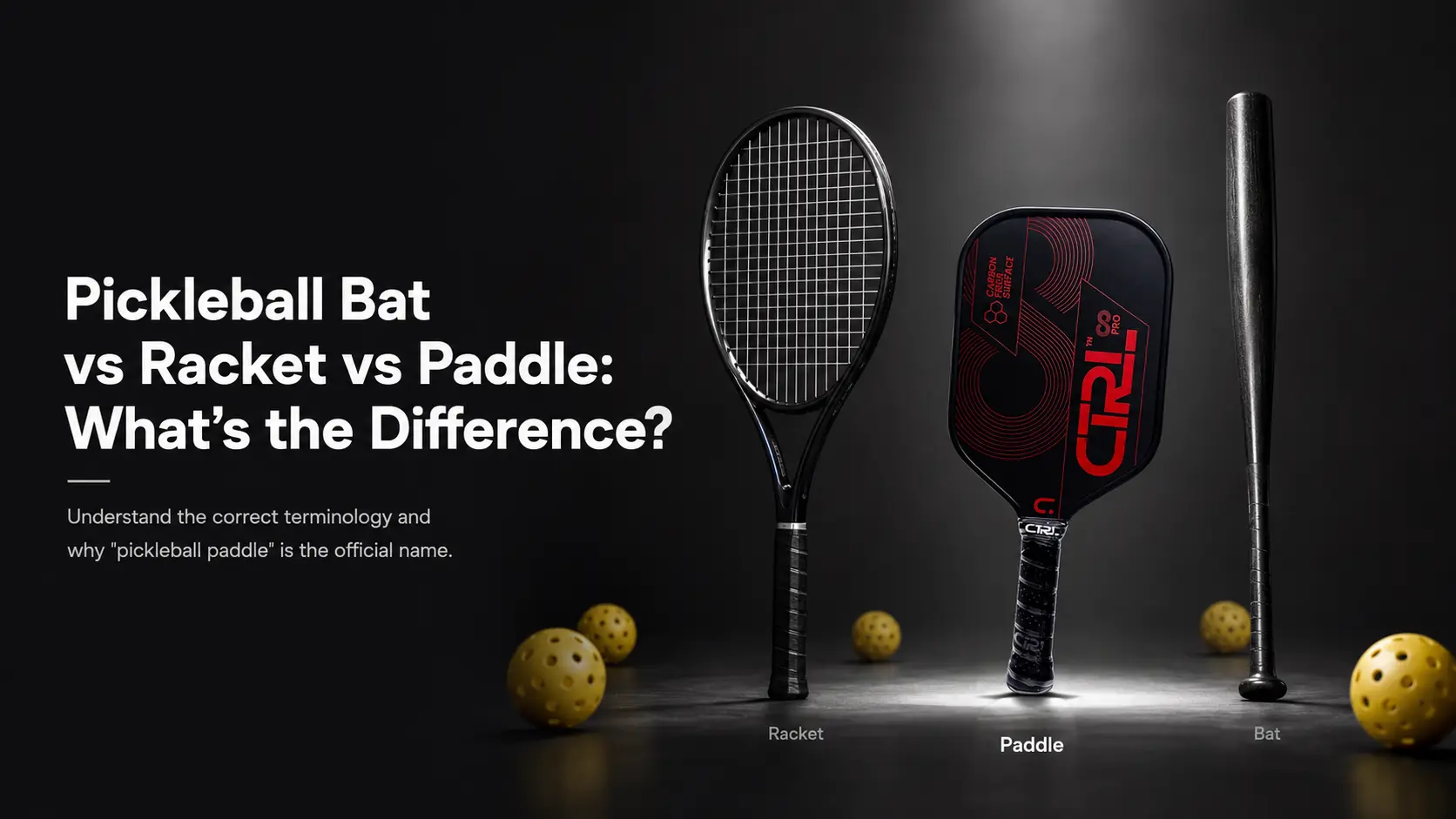
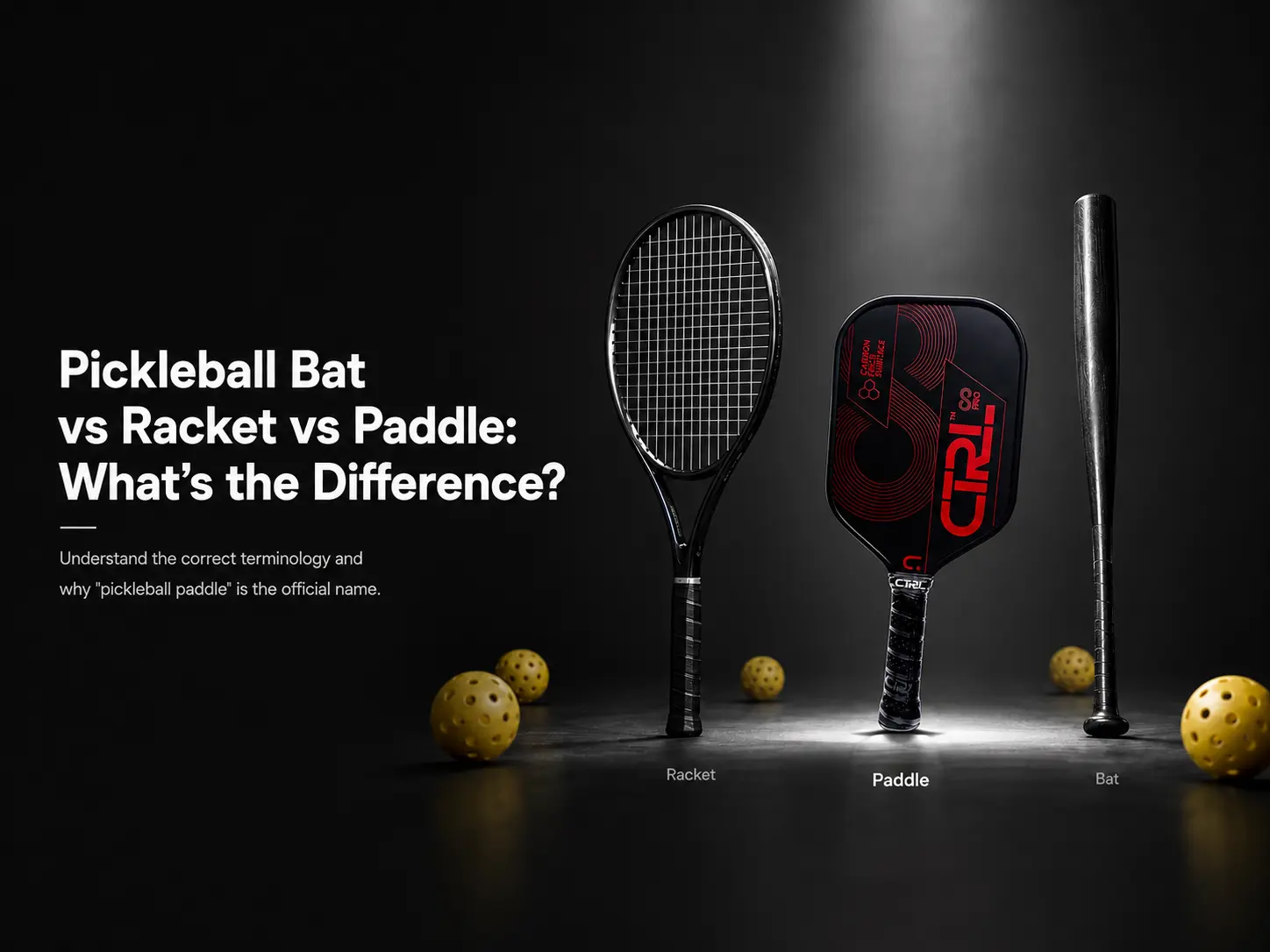
A pickleball bat, racket, and paddle all refer to the same piece of equipment - the solid, paddle-shaped tool used to hit the ball. “Paddle” is the official term used worldwide, while “racket” and “bat” are regional terms commonly used by Indian players instead. There is no actual equipment difference between them -just different words for the same product.
If you’ve been searching “pickleball racket price in India” and then stumbled onto a site selling “pickleball paddles” and wondered if you’re on the wrong page, you’re not. Here’s the full breakdown.
Why do people call it a Bat, Racket and Paddle?
The official term recognized by USA Pickleball and the International Federation of Pickleball is “paddle,” since the sport originated in the United States in the 1960s. In India, where pickleball is a newer addition to the racket-sports scene, players often default to “racket” (borrowed from tennis and badminton) or “bat” (borrowed from table tennis). All three words point to the exact same piece of equipment - the terminology difference is purely about which existing sports vocabulary a given region borrowed from when the sport arrived, not about any variation in the product itself.
Is it wrong to call it a racket?
No. It’s regional usage, not an error. Retailers, players, and even sports commentators in India use “racket” interchangeably with “paddle,” and both terms will get you to the right product when shopping online.
Why does India specifically use different terms than the rest of the world?
India’s racket-sports culture existed for decades before pickleball arrived, and that vocabulary shaped how the new sport was discussed. Tennis, badminton, and squash, all strung, string-based sports, have used "racket" as the default term across Indian sports media, retail, and everyday conversation for generations. Table tennis, similarly well-established, uses "bat." When pickleball began appearing in India roughly in the early 2020s, it landed in a linguistic environment where "racket" and "bat" were already the natural, familiar words for "the thing you hit a ball with," while "paddle," the term used in the sport's home market, the US, had no prior foothold in Indian sporting vocabulary.
This is a fairly common pattern with imported sports terminology: local vocabulary tends to route new, unfamiliar equipment names to the term already in use for a similar object, rather than adopting the imported term wholesale. It's part of why search data consistently shows Indian shoppers searching for "pickleball racket" several times more often than "pickleball paddle," even though "paddle" remains the technically official and most commonly used term in the sport's founding market and in most international rulebooks.
Is a pickleball paddle the same as a pickleball racket?
Yes - 100% the same product. There is no separate category of equipment called a “pickleball racket” that differs technically from a paddle. The confusion is purely linguistic, and it’s worth being explicit about this because a small number of new players genuinely worry they might be buying the wrong thing when a site’s terminology doesn’t match what they searched for.
Quick facts:
- Same shape, same official specifications, same rules apply regardless of what you call it.
- No brand or manufacturer makes a distinct “racket” version versus a “paddle” version.
- Indian shoppers search “racket” more often than “paddle” - but both return identical products on most retail sites.
- International product listings, reviews, and spec sheets almost universally use “paddle,” so if you’re comparing an Indian retailer’s listing against a global review or spec comparison, you’re still looking at the same category of product despite the different label.
What’s the difference between a pickleball paddle and a tennis or badminton racket?
Unlike a tennis or badminton racket, a pickleball paddle has no strings. It’s a solid-faced paddle - flat, rigid, and typically made from a fibreglass, carbon fibre, or graphite face over a polymer or Nomex core. A tennis or badminton racket, by contrast, uses a strung head to generate power and spin.
This matters practically: the hitting mechanics are different (a paddle relies on the paddle face’s surface texture for spin, not string tension), and the two are not interchangeable equipment. A strung racket flexes and rebounds the ball through tension across the string bed, which is part of why tennis and badminton rackets need regular restringing as tension loosens with use. A solid pickleball paddle has no strings to maintain - its performance instead depends on the face material’s texture and the core’s density, which is why paddle “wear” looks completely different from racket wear, as covered in our guide to how long a pickleball paddle lasts.
The court and net dimensions also differ significantly between the sports, which compounds the equipment difference - pickleball is played on a smaller court with a lower net than tennis, and doubles badminton court dimensions, closer to what pickleball actually uses, still don’t share the same net height or ball type. Even the way each sport’s equipment is regulated differs: strung rackets have their own governing specifications around string tension and pattern, while pickleball paddle regulations focus on surface roughness, thickness, and overall dimensions, since there’s no string bed to regulate at all.
Shop the CTRL Infinity Pro.
Can I use a badminton or tennis racket to play pickleball?
No. Official pickleball rules require a solid-faced paddle. A strung racket isn’t legal equipment in sanctioned play, and it won’t perform the same way even in casual games, since a strung head would produce very different, less controllable contact with pickleball’s harder plastic ball than it does with a felt tennis ball or a feathered or synthetic shuttlecock.
What’s the difference between a pickleball paddle and a table tennis bat?
A pickleball paddle and a table tennis bat share the same basic idea - a solid hitting surface with no strings - but differ meaningfully in size and construction:
- Size: A pickleball paddle is roughly 15.5-17 inches long; a table tennis bat is closer to 10 inches, including the handle
- Core material: Pickleball paddles use a polymer, Nomex, or aluminium core sandwiched between face layers; table tennis bats use a wooden blade covered in rubber
- Grip: Pickleball paddles have a longer handle designed for a two-handed backhand option; table tennis bats have a short handle built for close-net, wrist-driven play
- Playing surface: Table tennis is played on a small, elevated table with a net just a few inches high; pickleball is played on a full-sized court, closer in scale to a badminton doubles court, with a net roughly three feet high at the sidelines
They’re related in spirit - both emerged as smaller-scale, more accessible variations on existing racket sports, and both use a rigid, solid hitting surface rather than strings - but they’re not interchangeable. A table tennis bat isn’t legal or practical for pickleball, since its small size and lightweight wood-and-rubber construction can’t generate the power or durability that pickleball’s larger court and harder plastic ball demand. For a deeper look at what actually goes into a pickleball paddle’s construction, see our Core Materials Explained guide.
Does it matter which term you use at a club or with a coach?
No - coaches, club organizers, and fellow players across India will understand any of the three terms without confusion. Unlike, say, a technical rule or scoring term where precision matters, “bat,” “racket,” and “paddle” are simply regional vocabulary choices, and pickleball communities in India have generally become comfortable with all three being used interchangeably in casual conversation, coaching sessions, and even local tournament communication. New players sometimes worry unnecessarily about “sounding wrong” when picking up the sport’s vocabulary - this is one area where there’s genuinely no wrong choice.
If anything, you’ll likely hear a mix of all three terms within a single conversation at most Indian pickleball courts - a coach might refer to “paddle technique” while a fellow player asks to borrow your “racket,” and neither usage would be considered incorrect or confusing in context. The only place where consistent terminology matters more is in official rulebooks and international competition documentation, which use “paddle” as the standardised term to avoid any ambiguity across different countries’ regional preferences.
Does the terminology difference cause any real confusion when buying gear online?
Occasionally, yes - mostly around filtering and site navigation rather than actual product selection. Some Indian e-commerce platforms and general sporting goods sites categorise products under only one term, typically “racket” or “paddle” but not consistently both, which can mean a shopper searching the “wrong” term for that specific site gets zero results even though the product exists elsewhere on the same platform under different sports-equipment categories.
Specialist pickleball retailers generally avoid this problem by optimising product listings for both terms simultaneously, but general marketplaces and multi-sport retailers sometimes don’t, since their catalogue structure was often built around older, more established sports first, and pickleball was added later without fully reconciling regional terminology preferences into the site’s search and filter logic.
If a search for one term returns nothing on a given site, it’s worth trying the other before assuming the retailer doesn’t carry pickleball equipment at all - this single troubleshooting step resolves the vast majority of “I can’t find pickleball gear on this site” confusion that new Indian buyers sometimes run into.
Which term should you search for when buying online in India?
Use “pickleball racket” or “pickleball paddle” interchangeably when shopping online in India - both will surface the same products on most retail sites. “Bat” also works on many Indian platforms, though it’s slightly less common in product listings than the other two terms, so it’s worth trying “racket” or “paddle” first if a “bat” search returns fewer results than expected.
If you’re comparing options and want to see current picks by price and skill level, our Best Pickleball Rackets in India 2026 Price Guide breaks down what to buy at every budget.