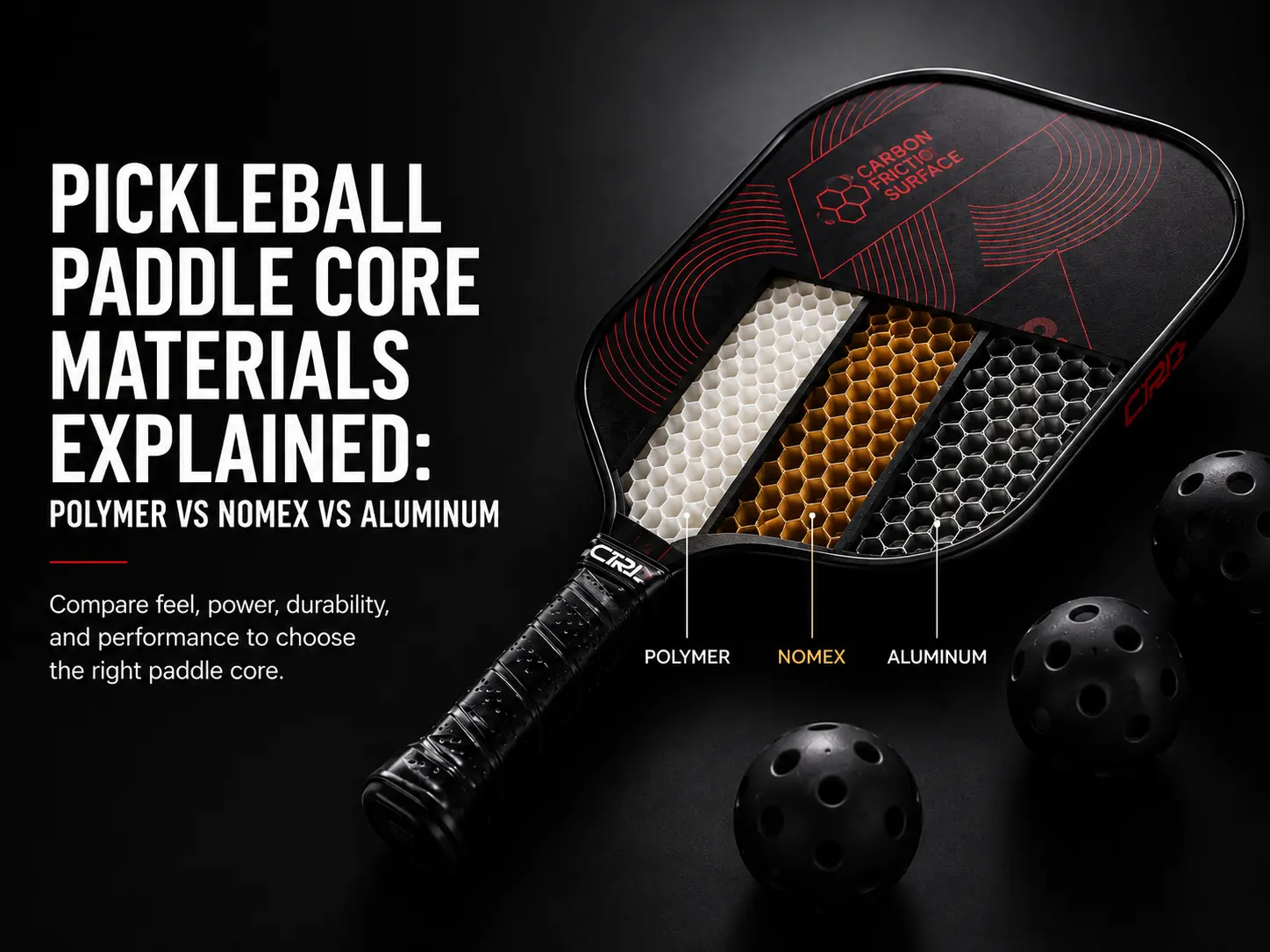
The core material inside a pickleball paddle determines its power, control, sound, and durability more than any other spec. Polymer cores offer the best balance of power and control and are used in most modern paddles. Nomex cores are harder and louder, delivering more power but less touch. Aluminum cores are lightweight and control-focused, favored by players who prioritize precision over pop.
If you've been comparing paddles and seeing "polymer core," "Nomex honeycomb," or "aluminum core" in the spec sheet without knowing what it actually changes about how the paddle plays, this guide breaks down each material, how they compare, and which one fits your game.
What is a pickleball paddle core and why does it matter?
The core is the internal layer sandwiched between a paddle's two outer face sheets, and it's the single biggest factor in how a paddle feels and performs. While the face material (carbon fiber, fiberglass, or graphite) affects spin and surface feel, the core determines the paddle's overall power, control ceiling, weight distribution, and the sound it makes on contact.
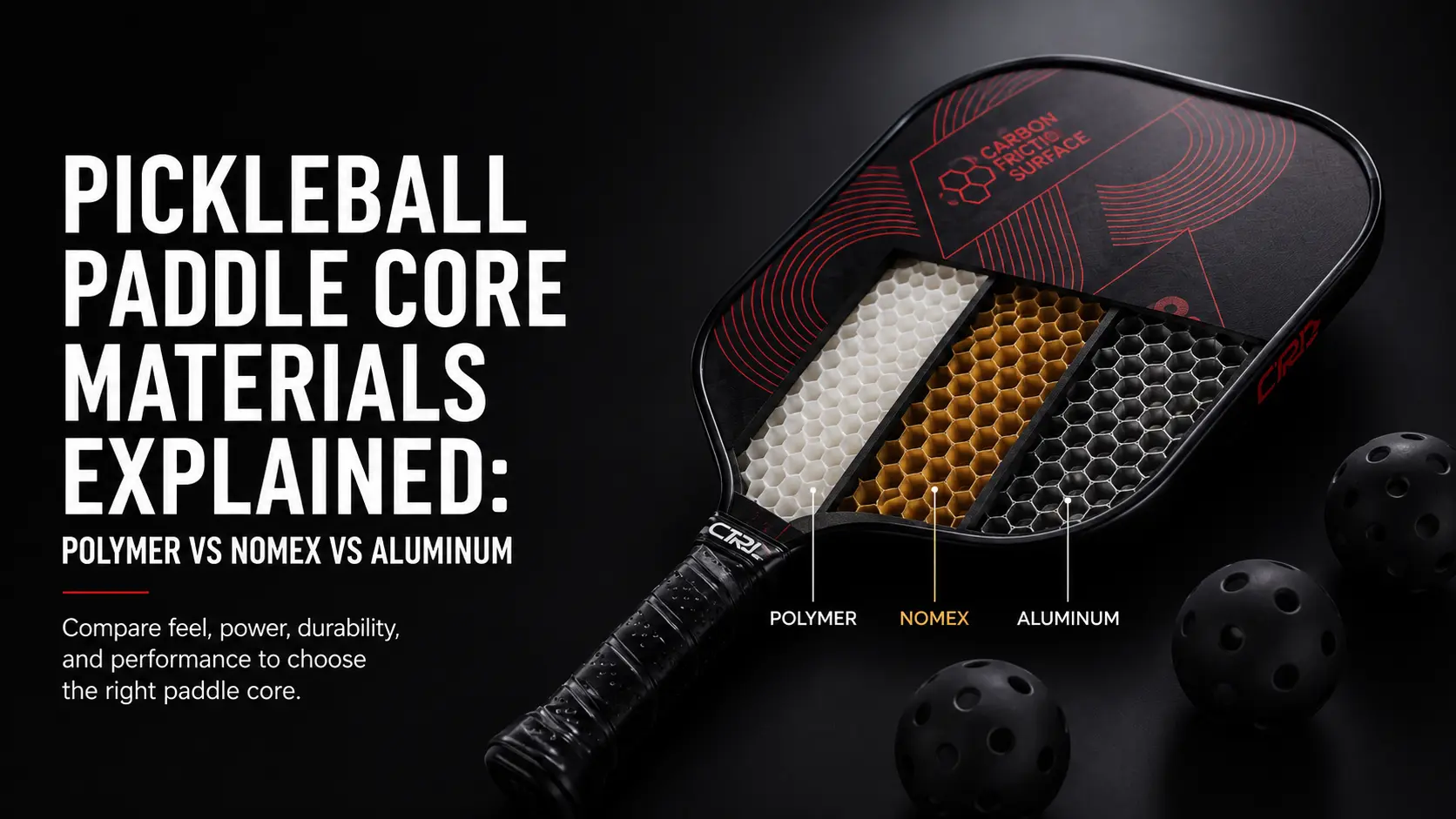
Manufacturers build cores using a honeycomb structure - a grid of small hexagonal or square cells - made from one of three common materials: polymer, Nomex, or aluminum. Each material has a different cell density, rigidity, and weight, which is why two paddles that look nearly identical on the outside can feel completely different in your hand.
Think of the core the way you'd think of a shoe's midsole: the outer material matters, but the core is what actually absorbs, transfers, and shapes the energy of every shot.
What is a polymer core paddle?
Polymer core paddles use a plastic honeycomb structure and are the most common core type in modern paddles, offering the best balance of power, control, and a soft feel. Polymer is softer than Nomex, which means it deadens the ball slightly on contact - giving players more time to feel and control the shot, especially on dinks and resets at the kitchen line.
Why polymer dominates the market today:
- Quiet sound profile - increasingly important as noise complaints affect where pickleball can be played in residential areas
- Softer feel - better touch on soft shots, less "pingy" than harder core materials
- Consistent power-to-control ratio - works well across all skill levels, not just beginners or advanced players
- Durability - polymer cells resist compression over time better than older core technologies
The main trade-off: polymer paddles generally produce slightly less raw power than a comparable Nomex paddle, since the softer cell structure absorbs more energy on contact rather than returning it to the ball.
What is a Nomex core paddle?
Nomex is a resin-coated fiber material, originally developed for fire-resistant applications, that was one of the earliest core materials used in pickleball paddles. It's significantly harder and denser than polymer, which produces a "poppier," more powerful response off the paddle face.
Characteristics of Nomex core paddles:
- Higher power output - the rigid honeycomb structure returns more energy to the ball on contact, useful for players who rely on drives and put-aways
- Louder sound - Nomex paddles are noticeably louder than polymer, which has made them less popular as noise-restriction rules have become more common at pickleball facilities
- Less forgiving - the hard surface offers less control on touch shots, making it harder for beginners and intermediate players to soften dinks
- More affordable - Nomex is generally cheaper to manufacture, so Nomex-core paddles are often found at lower price points
Nomex was the dominant core material in pickleball's earlier years but has been largely overtaken by polymer as manufacturing improved and player preferences shifted toward control-oriented play.
What is an aluminum core paddle?
Aluminum core paddles use a metal honeycomb structure that prioritizes light weight and control over raw power. Aluminum cells are typically thinner and lighter than both polymer and Nomex, which shifts the paddle's overall weight and swing balance toward maneuverability.
Where aluminum performs best:
- Lightweight builds - ideal for players managing wrist or elbow strain, or those who prefer a faster hand-speed at the net
- Precision-focused play - better suited to finesse-oriented players than power hitters
- Fast reaction volleys - the lighter swing weight helps at the kitchen line during fast exchanges
The trade-off is durability and power: aluminum cores are more prone to denting under repeated hard impacts compared to polymer, and they generally produce the least power of the three core types. Aluminum-core paddles are a smaller share of the current market, typically chosen by a specific type of control-first player rather than as a default recommendation.
Polymer vs Nomex vs Aluminum: which is best for your skill level?
For most players buying their first or second paddle, polymer core is the safest and most versatile choice - it's what the majority of top-selling paddles use today, and it performs well across nearly every playing style without a steep learning curve.
How does core material affect power, control, and spin?
Core material has the biggest impact on power and control, while spin is influenced more by the paddle's face material and surface texture. That said, the core still plays a supporting role in spin generation - a softer polymer core holds the ball on the paddle face fractionally longer during contact, giving players slightly more time to brush upward for topspin.
In terms of power, the ranking is generally Nomex > Polymer > Aluminum, from hardest/most powerful to softest/most control-oriented. In terms of control and touch, the order flips: Aluminum and Polymer outperform Nomex for dinks, drop shots, and resets, since the harder Nomex surface makes it more difficult to deaden the ball on soft contact.
Does core material affect noise?
Yes - core material is one of the biggest factors in how loud a paddle is, and this has become a genuinely important buying consideration as more residential communities and apartment complexes in India restrict pickleball play due to noise. Polymer cores are noticeably quieter than Nomex, which is part of why polymer has become the default choice for most manufacturers building "quiet" or "low-noise" paddle lines.
If you're setting up a court near a residential building or in a shared community space, a polymer-core paddle is generally the more considerate - and often the required - choice.