.webp)
%20thbnl.webp)
Pickleball is one of the fastest-growing sports in India, attracting players of all ages and skill levels. The game is easy to learn, fun to play, and requires minimal equipment compared to many other sports.
However, if you are new to the sport, you might be wondering:
What are the basic rules of pickleball?
Understanding the rules is important because it helps players enjoy the game while avoiding common mistakes during matches.
Pickleball combines elements of tennis, badminton, and table tennis, but it has its own unique rules and gameplay style.
In this beginner-friendly guide, we will explain:
- The basic rules of pickleball
- How scoring works
- Serving rules
- The non-volley zone (kitchen) rule
- Tips for beginners learning the game
By the end of this guide, you will have a clear understanding of how pickleball is played.
What Is Pickleball?
Pickleball is a paddle sport played on a court that is similar in size to a badminton court.
Players use solid paddles and a plastic ball with holes to hit the ball over a net.
Pickleball can be played in two formats:
Singles
One player on each side of the court.
Doubles
Two players on each side of the court.
Doubles is the most common format and is widely played in recreational and competitive matches.
Pickleball Court Layout
A pickleball court measures 20 feet wide and 44 feet long.
The court includes several important areas:
Baseline
The line at the back of the court.
Sidelines
The boundaries on the left and right sides.
Service Courts
The areas where players serve the ball.
Non-Volley Zone (Kitchen)
A special area near the net where certain shots are restricted.
Understanding these areas is important for learning the rules of the game.
How Pickleball Matches Start
Every pickleball match begins with a serve.
The serve determines which player or team starts the rally.
In doubles matches, each team gets the opportunity to serve before the opposing team receives the serve.
Players must follow specific rules when serving the ball.
Pickleball Serving Rules
Serving is one of the most important parts of pickleball.
The serve must follow several basic rules.
Underhand Serve
The ball must be served using an underhand motion.
This means the paddle must contact the ball below the player’s waist.
Serve Direction
The serve must be hit diagonally across the court into the opponent’s service area.
If the ball lands outside the service court, the serve is considered a fault.
Serve Behind the Baseline
The server must stand behind the baseline when hitting the serve.
Stepping on the baseline before hitting the ball results in a fault.
Only One Serve Attempt
Unlike tennis, players only get one serve attempt.
If the serve is missed, the opposing team receives the serve.
The Two-Bounce Rule
One of the most unique rules in pickleball is the two-bounce rule.
This rule helps create longer rallies and prevents players from dominating the net immediately.
The rule works as follows:
- The serving team serves the ball.
- The receiving team must allow the ball to bounce before returning it.
- The serving team must also allow the return to bounce before hitting it.
After these two bounces occur, players are free to volley the ball.
This rule ensures that rallies start fairly and encourages strategic gameplay.
The Non-Volley Zone (Kitchen)
The non-volley zone, commonly known as the kitchen, is an important part of pickleball.
The kitchen is the area within 7 feet of the net on both sides.
Players are not allowed to volley the ball while standing inside the kitchen.
A volley occurs when a player hits the ball before it bounces.
Kitchen Rule
Players cannot step into the kitchen and hit a volley.
However, players can enter the kitchen to hit the ball after it has bounced.
The kitchen rule prevents players from standing near the net and smashing every shot.
This rule encourages strategic play and longer rallies.
Pickleball Scoring Rules
Pickleball uses a unique scoring system.
Only the Serving Team Can Score
Points are only awarded to the team that is serving.
If the receiving team wins the rally, they gain the opportunity to serve but do not score a point.
Games Are Played to 11 Points
Most pickleball games are played to 11 points, but a team must win by at least 2 points.
For example:
- 11–9 is a valid win
- 11–10 is not enough to win
The game continues until one team leads by two points.
Doubles Scoring System
In doubles matches, the score is announced in three numbers:
Example:
5 – 3 – 1
This means:
- Serving team score: 5
- Receiving team score: 3
- Server number: 1
This system helps players keep track of who should be serving.
Common Faults in Pickleball
A fault occurs when a player breaks a rule during gameplay.
Some common faults include:
- hitting the ball out of bounds
- failing to clear the net
- volleying inside the kitchen
- serving incorrectly
- stepping on the baseline during a serve
When a fault occurs, the rally ends.
Basic Pickleball Shots
As beginners learn the game, they will encounter several common shots.
Serve
The serve starts every rally.
It must be hit underhand and land in the opponent’s service court.
Volley
A volley is when a player hits the ball before it bounces.
Volleys cannot be performed inside the kitchen.
Groundstroke
A groundstroke occurs when the ball is hit after bouncing on the court.
Dink Shot
A dink is a soft shot played near the net that lands inside the opponent’s kitchen.
This shot is used to control the pace of the game.
Equipment Needed to Play Pickleball
To play pickleball, players need a few basic pieces of equipment.
Pickleball Paddle
The paddle is the main piece of equipment used to hit the ball.
Beginners should choose paddles that provide balanced control and comfort.
Some recommended paddles include:
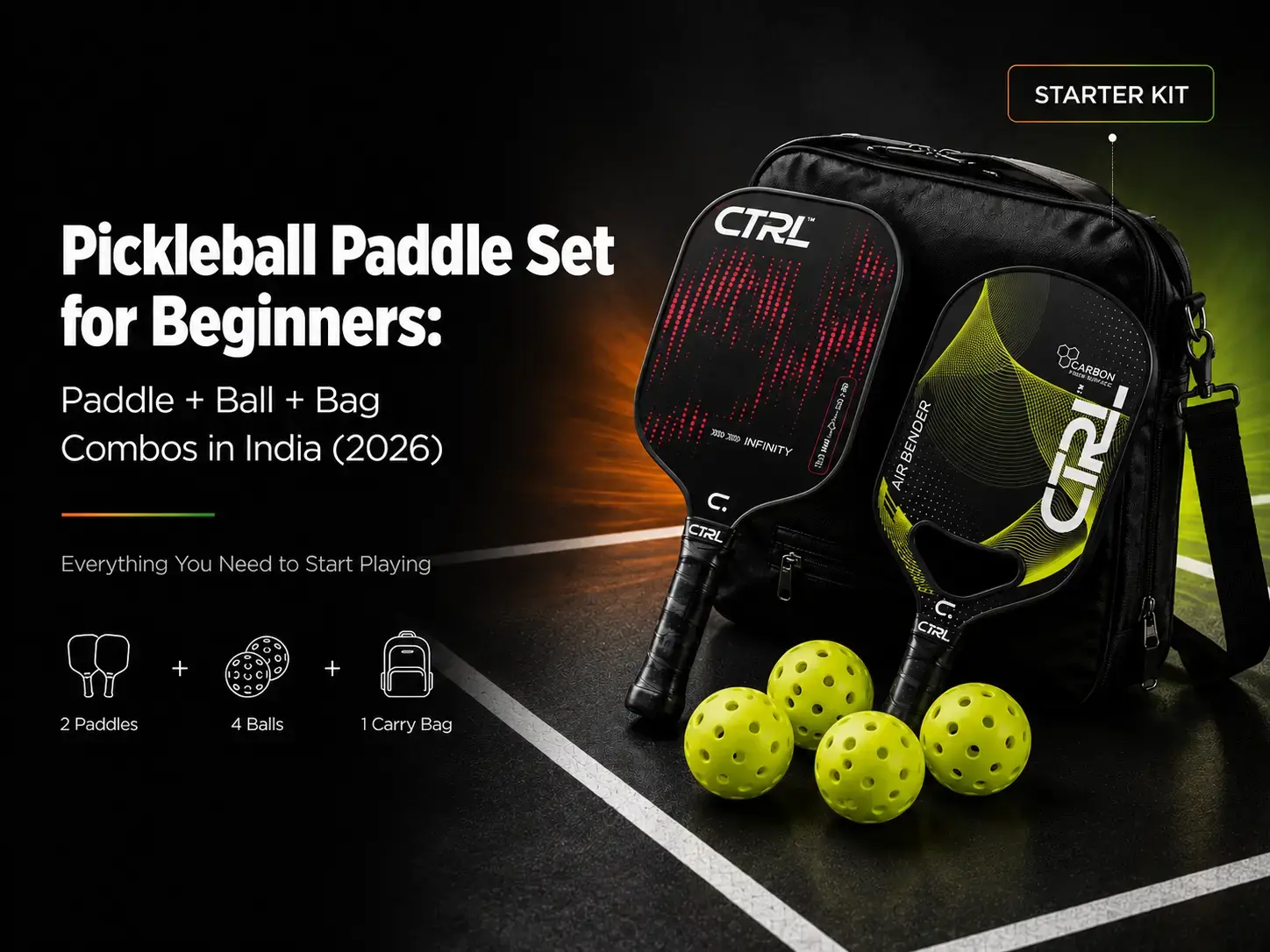
- CTRL Infinity Paddle – ₹1,799 (great for beginners)
- CTRL Infinity Pro Paddle – ₹4,399 (for intermediate players)
- CTRL Airbender Paddle – ₹7,499 (for advanced players)
Pickleball Balls
Pickleball balls are plastic balls with small holes.
They are available in indoor and outdoor versions.
Pickleball Net
The net divides the court and must be 36 inches high at the sidelines and 34 inches at the center.
Tips for Beginners Learning Pickleball
New players can improve their gameplay by following a few simple tips.
Focus on Control
Beginners should focus on accurate shots instead of trying to hit the ball with maximum power.
Practice Dinking
Dinking helps players develop control and maintain longer rallies.
Work on Footwork
Moving quickly and positioning yourself correctly can improve shot accuracy.
Play Regularly
Consistent practice helps players improve their skills faster.
Why Pickleball Is Growing in India
Pickleball is gaining popularity in India because it is:
- easy to learn
- fun and social
- suitable for all ages
- affordable to start
Many sports clubs and residential communities are now building pickleball courts, making the sport accessible to more players.
As awareness continues to grow, more players are joining the pickleball community across India.
Final Thoughts
Pickleball is an exciting sport that is easy for beginners to learn and enjoyable for players of all ages.
Understanding the basic rules including serving rules, the two-bounce rule, and kitchen restrictions helps players enjoy the game while improving their skills.
With the right equipment, proper technique, and regular practice, beginners can quickly become confident pickleball players.
As the sport continues to grow in India, more players are discovering the fun and competitive nature of pickleball.